17 min readUpdated November 12, 2026
What this guide covers
- Quick answer: Why Does Milk Collect Inside the Anti-Colic Vent Tube?
- Is It Normal for Milk to Get Into an Anti-Colic Vent Tube?
- First, Understand What the Anti-Colic Vent Tube Does
- 8 Reasons Milk Collects Inside an Anti-Colic Bottle Vent Tube
- How to Tell When Milk Is Entering the Vent Tube
- Why Does My Dr. Brown’s Vent Tube Fill With Milk but Another Bottle Works Fine?
- Why Does Milk Collect in the Vent Tube Only When the Bottle Is Half Empty?
- Why Does Milk Leak Around the Bottle Collar When the Vent Tube Fills?
- Does Milk Trapped in the Vent Tube Mean My Baby Drank Less?
- How to Clean Milk Out of an Anti-Colic Vent Tube
- Can You Remove the Anti-Colic Vent Tube and Still Use the Bottle?
- When Should You Replace the Vent Tube?
- When Is This More Than a Bottle Problem?
- Frequently Asked Questions About Milk in Anti-Colic Vent Tubes
- Final Thoughts
- Related GetBabyInfo Guides
- References
You prepare a bottle, feed your baby, and start taking everything apart for washing. Then you notice something strange: milk has collected inside the long plastic vent tube.
Maybe it is only a few drops. Maybe the reservoir is noticeably full. Or perhaps milk has started leaking around the bottle collar, leaving a wet patch on your baby’s clothes.
The first thought is usually, Isn’t this tube supposed to carry air, not milk?
That is a reasonable question. An anti-colic vent system is designed to manage airflow, so finding milk inside it can make you wonder whether the bottle is working properly.
The answer depends on when the milk got there.
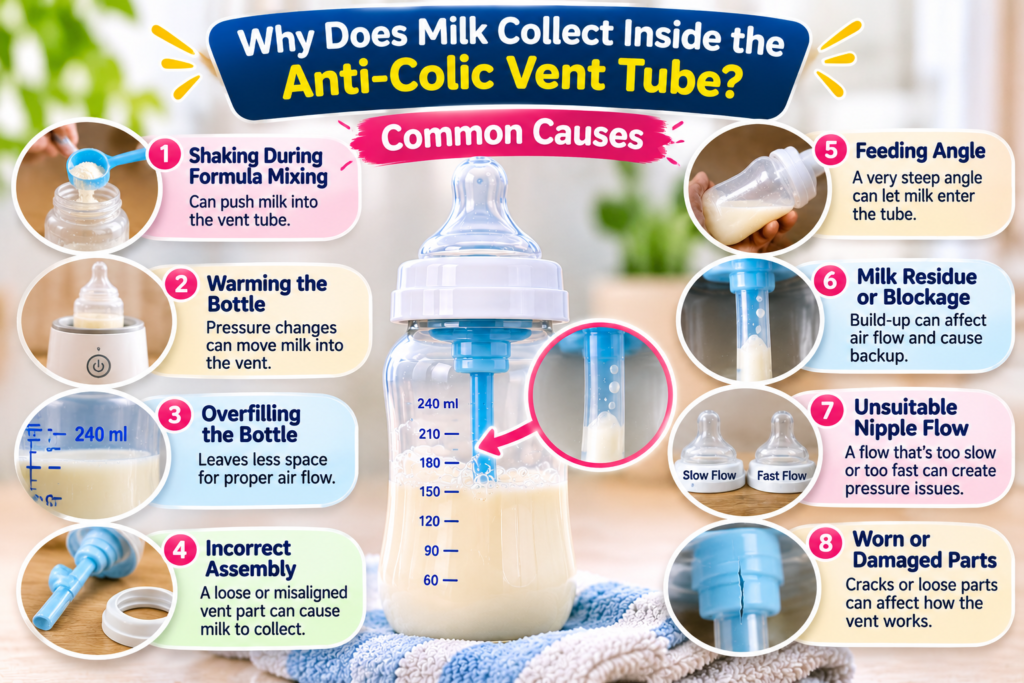
Milk can enter an anti-colic vent system during formula mixing, bottle warming, feeding, or handling. In some cases, the bottle is working as designed. In others, the problem comes from incorrect assembly, overfilling, pressure buildup, or damaged components.
If you use Dr. Brown’s bottles, there are several specific things worth checking before buying replacement parts.
Quick answer: Why Does Milk Collect Inside the Anti-Colic Vent Tube?
A small amount of milk or condensation inside an anti-colic bottle’s vent system does not always mean something is wrong. However, milk repeatedly collecting in the vent tube, leaking through the collar, or interfering with feeding may indicate an assembly problem, a blocked vent, an unsuitable feeding angle, or a damaged component.
The first thing to check is where the milk is collecting. Milk inside the bottle’s intended reservoir is different from milk trapped in an air channel that should remain clear.
The correct fix depends on the bottle’s design. Not every anti-colic bottle uses the same ventilation system.
Is It Normal for Milk to Get Into an Anti-Colic Vent Tube?
A small amount of milk inside a vent assembly does not automatically mean the bottle is defective.
However, a tube that repeatedly fills with milk, causes leaks, or interferes with feeding should not be ignored.
The key is to separate three situations:
A few drops after feeding: This may be residual liquid from the way the bottle was held or handled. Check your manufacturer’s instructions.
Milk collecting during preparation or warming: The liquid may have entered the vent because of shaking or pressure changes.
Milk repeatedly filling the vent during feeding: Bottle angle, assembly, fill level, or the way the vent system is functioning may need attention.
For example, Dr. Brown’s explains that shaking formula with its internal vent installed can push liquid into the vent. Heating a tightly closed bottle can also force liquid through the ventilation system.
That is why the timing of the problem matters more than simply finding milk in the tube.
First, Understand What the Anti-Colic Vent Tube Does
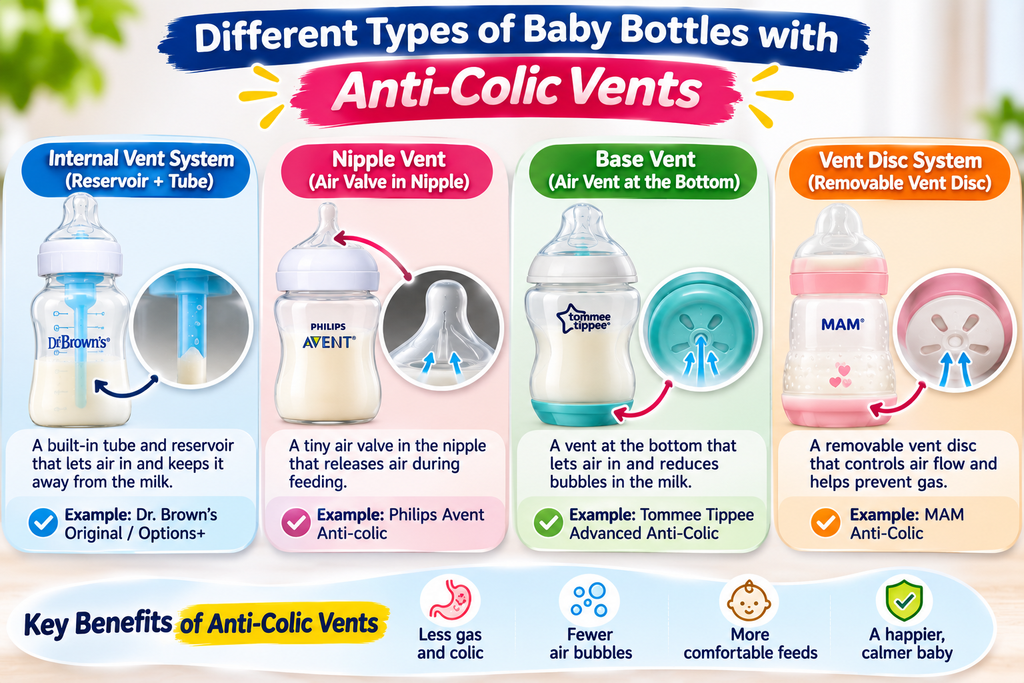
Not all anti-colic bottles work in the same way.
Some bottles have a valve in the nipple. Others use a vent at the base. Dr. Brown’s Original and Options+ bottles may use a removable internal vent system.
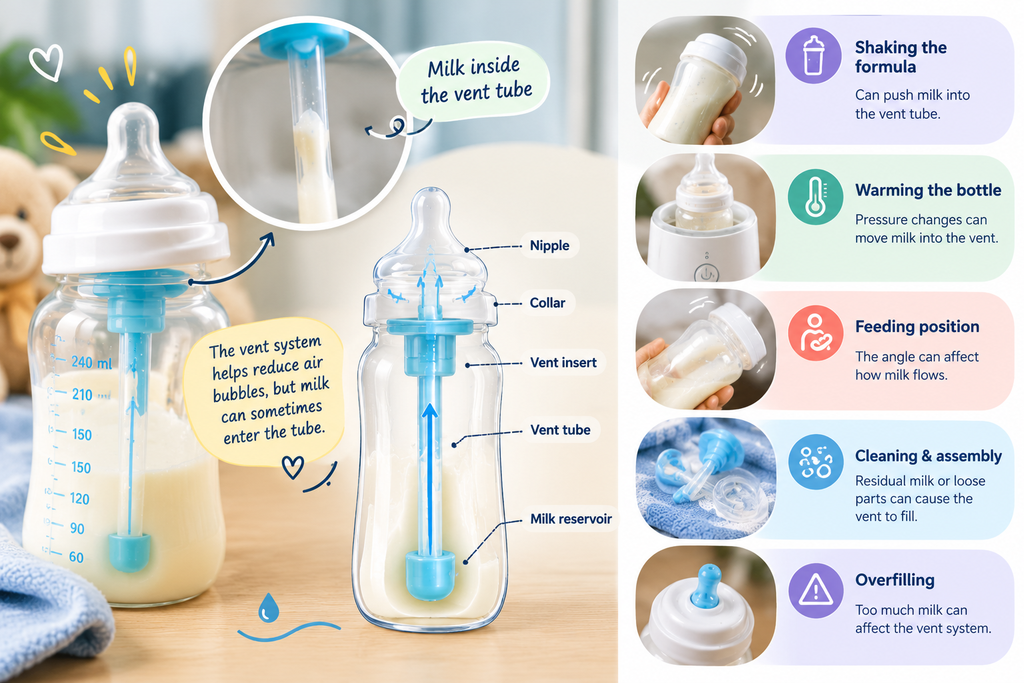
In these bottles, the internal assembly includes a vent insert and a long reservoir tube.
The system helps manage pressure as your baby drinks.
Without adequate airflow, a vacuum can develop inside certain bottle designs. This may affect how milk flows through the nipple.
The internal tube is part of the ventilation system. It is not intended to act as a second drinking straw.
One detail is especially important: the nipple, vent insert, reservoir tube, and bottle collar work together.
A problem with one component can affect the way the complete bottle functions.
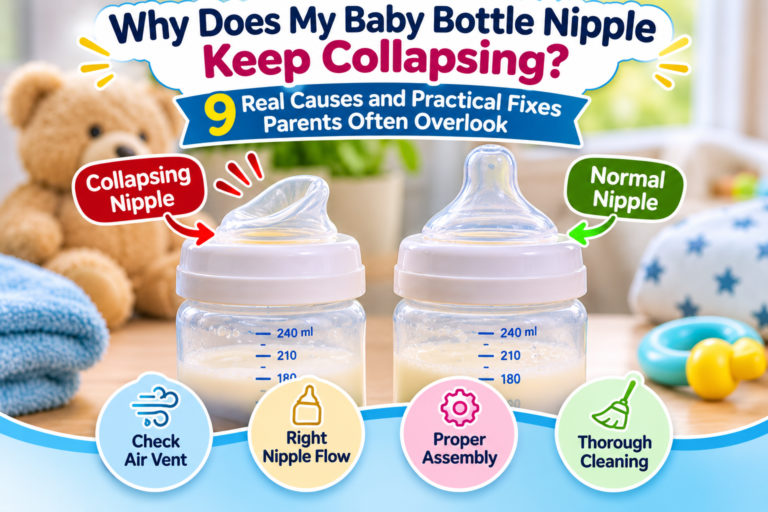
If your baby’s bottle nipple also folds inward during feeding, see our guide, Why Does My Baby Bottle Nipple Keep Collapsing? 9 Real Causes and Practical Fixes Parents Often Overlook.
[Add the published GetBabyInfo URL here.]
8 Reasons Milk Collects Inside an Anti-Colic Bottle Vent Tube
1. You Shake the Formula With the Vent Tube Already Installed
This is one of the first things I would check.
When preparing formula, it is common to fill the bottle with water, add the measured powder, assemble everything, and shake until the powder dissolves.
But with some internal vent systems, shaking the fully assembled bottle can push liquid into the vent.
Dr. Brown’s specifically warns about this in its bottle-preparation guidance.
What to do instead
Follow the instructions for your exact bottle model.
For Dr. Brown’s bottles, the manufacturer recommends gently stirring formula to reduce air bubbles and help prevent liquid from entering the vent. If shaking is needed, its guidance says to remove the vent components and use the appropriate travel cap before shaking.
The CDC also recognizes shaking or swirling as methods for mixing formula. The important point is to use a method that is safe for your formula and compatible with your bottle’s design.
Always measure water and formula powder exactly as directed. Do not change the formula concentration to prevent vent problems.
A useful clue: If the vent contains milk before your baby has taken a single sip, investigate the preparation routine first.
2. You Warm the Bottle With the Vent Assembly Inside
Imagine placing a fully assembled bottle into a warmer.
The milk gets warmer, and the air inside the bottle expands. Depending on how tightly the bottle is closed, pressure can build.
In some vented bottles, that pressure can push milk into the internal vent system.
Dr. Brown’s recommends removing its internal vent components before warming to help prevent pressure-related leaks.
What to check
Does the tube fill with milk only after warming?
Does the bottle leak around the collar when you remove it from the warmer?
Does the same problem happen when you prepare a bottle that does not need warming?
These observations can help you identify whether warming is involved.
Follow your bottle manufacturer’s warming instructions. Never microwave breast milk or formula because uneven heating can create dangerous hot spots.
Also remember that infant formula does not always need to be warmed. Some babies are comfortable drinking it at room temperature when it has been prepared and stored safely.
3. The Bottle Is Filled Above Its Recommended Limit
An anti-colic bottle needs to be used within its designed capacity.
If the liquid level is above the manufacturer’s maximum-fill marking, the ventilation system may not work as intended.
For bottles with an internal vent, overfilling can increase the likelihood of milk entering the vent assembly or leaking.
What parents should check
Look for a maximum-fill line or warning on the bottle.
Do not assume that the highest measurement marking is necessarily the maximum permitted fill level for every model.
Also remember that adding formula powder increases the final liquid volume.
Measure the water first according to the formula instructions, then add the correct amount of powder.
Never reduce the amount of water to make extra room in the bottle.
If the prepared volume exceeds the bottle’s permitted capacity, use an appropriately sized bottle.
4. The Vent Tube Is Not Connected Firmly to the Insert
This problem can begin after an ordinary cleaning session.
You wash the bottle, clean the narrow tube, and put everything back together.
The tube looks attached, but the connection may not be fully seated.
Dr. Brown’s assembly instructions explain that the reservoir tube and insert should fit securely together.
If the connection is loose or incorrectly positioned, the vent system may not work as intended.
A practical check
After cleaning and drying the bottle, compare the assembled parts with the diagram supplied by the manufacturer.
Check whether the reservoir tube is securely connected.
Look for cracks, distortion, or damaged plastic around the connection.
If a part does not fit properly, do not force it or repair it with household materials.
Replace damaged parts with manufacturer-approved components.
5. You Hold the Bottle at an Angle That Affects the Vent
Bottle position matters, but there is no single angle that is appropriate for every bottle design and every baby.
Dr. Brown’s UK troubleshooting guidance recommends holding its bottle at approximately a 45-degree angle during feeding, with the end of the reservoir tube out of the milk.
That is a model-specific recommendation.
Other infant-feeding guidance emphasizes responsive feeding, comfortable positioning, and allowing babies to manage the flow.
What should you do?
Check the instructions for your exact bottle.
Hold your baby in a supported position and observe whether feeding is comfortable.
Avoid changing the bottle angle simply to keep the tube empty if that causes milk to flow too quickly.
If milk repeatedly enters the vent at the same stage of feeding, note how the bottle is positioned at that moment.
This may help when troubleshooting with the manufacturer.
6. The Vent Contains Dried Milk or Formula Residue
Anti-colic bottles often have more small components than ordinary bottles.
That makes cleaning especially important.
Milk and formula can leave residue inside narrow tubes, around vent openings, and where plastic components connect.
A vent may look clean from the outside while residue remains in a small passage.
What I would check first
Remove the vent tube and inspect it under good lighting.
Look at both ends of the tube, not just the middle.
Check the connection point between the reservoir and insert.
If the manufacturer supplies a small cleaning brush, use it according to the instructions.
Never use a needle or pin to clear the vent.
Residue does not automatically explain why milk is entering the tube, but keeping the ventilation system clean helps prevent avoidable equipment problems.
If your bottle also develops a sour or unpleasant odor, read our related article:
Why Does My Baby Bottle Smell Bad After Washing?
7. The Nipple Flow Is Not Comfortable for Your Baby
This is worth considering when milk in the vent appears alongside feeding difficulties or leaks.
Dr. Brown’s explains that an unsuitable nipple flow can contribute to certain leaking problems during feeding.
For example, if the flow is too slow for a baby’s needs, the baby may suck harder, potentially affecting pressure within the system.
However, that does not mean a faster nipple is always the solution.
Look at your baby’s feeding behavior
Does your baby seem frustrated?
Are feeds unusually tiring?
Does your baby repeatedly pull away?
Does milk spill from the mouth?
Does your baby cough or splutter?
These signs may have several explanations, including feeding coordination difficulties.
Do not increase nipple flow solely because milk is appearing in the vent.
If feeding difficulties continue, ask your pediatrician or a qualified infant-feeding professional for guidance.
8. The Vent Assembly Is Damaged or No Longer Fits Properly
Bottle parts are handled repeatedly.
They are washed, dried, sterilized when appropriate, and reassembled.
Over time, components can become worn or damaged.
Look for cracks, chips, warped plastic, damaged seals, and connections that no longer fit securely.
A damaged component may contribute to leaking or improper ventilation.
If you notice damage, replace the affected part.
Do not attempt to fix a cracked vent tube with glue, tape, or heat.
If the bottle is new and the problem continues despite correct use, contact the manufacturer. A replacement part may be more appropriate than replacing the entire bottle.
How to Tell When Milk Is Entering the Vent Tube
One of the easiest ways to make troubleshooting less frustrating is to identify the stage when the problem begins.
| When you notice milk in the vent | What to investigate first |
|---|---|
| Immediately after mixing formula | Mixing method and whether the vent was installed |
| After warming the bottle | Warming instructions and pressure buildup |
| Before feeding, after filling | Fill level and assembly |
| Halfway through feeding | Bottle position, vent function, feeding pattern |
| After the bottle leaks | Collar, vent connection, warming, fill level |
| After washing | Residual rinse water, drying, and reassembly |
| Only with one bottle | Condition and fit of that bottle’s components |
This table is a troubleshooting guide, not proof of a particular defect.
Why Does My Dr. Brown’s Vent Tube Fill With Milk but Another Bottle Works Fine?
If two bottles of the same model behave differently, compare their components.
Start with the reservoir tube and insert.
Are both assembled in the same way?
Does one have a damaged connection?
Are you using compatible nipples?
Are both bottles filled to the same permitted level?
Has one been warmed or shaken differently?
A difference between bottles can be useful information, but it does not automatically prove that one bottle is defective.
If the problem continues with only one bottle, contact the manufacturer with the exact model and a description of what happens.
Why Does Milk Collect in the Vent Tube Only When the Bottle Is Half Empty?
This can be confusing because the bottle may work normally at first.
As the milk level drops, parents sometimes adjust the angle to keep milk reaching the nipple.
That changes the position of the remaining liquid relative to the vent components.
A change in bottle position may contribute to milk entering a particular vent design.
However, the timing alone cannot identify the cause.
Try to notice whether the issue happens at a consistent point in the feed without deliberately forcing the problem to occur.
If your baby is comfortable but the tube repeatedly fills, check the manufacturer instructions.
If your baby also struggles to drink, consider whether the nipple flow or feeding technique needs assessment.
Why Does Milk Leak Around the Bottle Collar When the Vent Tube Fills?
Milk inside the vent and milk leaking outside the bottle are related but separate observations.
In some Dr. Brown’s bottles, liquid that enters the vent system can eventually escape around the collar.
The manufacturer identifies several contributing situations, including shaking, overheating, overfilling, and certain nipple-flow problems.
What to do
Stop using a bottle that is actively leaking until you have checked it.
Inspect the collar, nipple, vent insert, and reservoir connection.
Review how the bottle was mixed and warmed.
Check the fill line.
Reassemble everything according to the instructions.
If the leak continues, contact the manufacturer.
Avoid treating excessive tightening as the solution. Some bottles can develop problems when the collar is overtightened.
Does Milk Trapped in the Vent Tube Mean My Baby Drank Less?
Not necessarily.
A few drops left inside a component do not tell you whether your baby received enough milk.
There is a difference between a small amount of residual liquid and a bottle that loses a substantial amount through leaking.
If you are tracking intake, look at the overall feeding pattern rather than trying to calculate intake from the vent tube alone.
Consider your baby’s wet diapers, growth, feeding comfort, and your healthcare professional’s recommendations.
If your baby consistently drinks less than expected, has fewer wet diapers, or is not gaining weight appropriately, contact your pediatrician.
How to Clean Milk Out of an Anti-Colic Vent Tube
Cleaning the narrow vent is one of the less convenient parts of using an anti-colic bottle.
It is tempting to rinse the tube quickly and put it back.
But milk residue can remain in small spaces, so the CDC recommends cleaning all infant feeding components after every feeding.
A reliable cleaning routine
- Wash your hands before handling bottle parts.
- Disassemble the bottle completely, including removable vent components.
- Rinse the parts under running water.
- Wash with hot, soapy water in a dedicated clean basin, or use a dishwasher if the manufacturer permits it.
- Clean the narrow vent tube with the appropriate manufacturer-approved brush.
- Rinse thoroughly to remove soap and visible residue.
- Place the parts on a clean, unused towel or paper towel and allow them to air-dry fully.
- Reassemble only when the components are clean and dry.
Do not rub the inside of the tube with a used dish towel.
The CDC recommends daily sanitizing particularly for babies younger than two months, babies born prematurely, and babies with weakened immune systems.
For older, healthy babies, daily sanitizing may not be necessary when items are cleaned carefully after every use.
If you notice chalky deposits or persistent cloudiness, see our related article, White Film Inside Baby Bottles: Is It Hard Water, Formula Residue, or Something Else?
[Insert the verified published GetBabyInfo link.]
Can You Remove the Anti-Colic Vent Tube and Still Use the Bottle?
Some parents want to remove the tube because cleaning it takes extra time or milk keeps getting trapped inside.
Whether that is safe depends on the exact bottle model.
For example, Dr. Brown’s states that its green Options+ vent system can be removed when appropriate, but its blue Natural Flow vent must remain in place.
These products are not interchangeable in how they are intended to function.
Do not remove an internal vent simply because another parent says their bottle works without it.
Check the model instructions before changing how the bottle is assembled.
When Should You Replace the Vent Tube?
A vent tube does not need replacing simply because a little milk entered it.
Replacement becomes more important when the component is cracked, distorted, damaged, or no longer fits securely.
Also follow the manufacturer’s replacement instructions.
If the tube repeatedly fills despite correct preparation, cleaning, and assembly, contact the manufacturer before buying several new parts.
Sometimes the problem is related to the feeding routine rather than the component itself.
When Is This More Than a Bottle Problem?
Milk collecting in a vent tube is usually a reason to inspect the equipment.
But persistent feeding difficulties deserve separate attention.
Contact your baby’s healthcare professional if you notice repeated coughing, spluttering, difficulty feeding, unusual fatigue during feeds, poor intake, fewer wet diapers, or concerns about weight gain.
Seek urgent medical help if your baby has trouble breathing, turns blue, becomes unresponsive, or appears to be choking.
A new bottle or nipple should not replace an assessment when your baby is struggling to feed.
Frequently Asked Questions About Milk in Anti-Colic Vent Tubes
Is milk supposed to go into the Dr. Brown’s vent tube?
The vent is designed to manage airflow, but milk can enter it under certain conditions. Dr. Brown’s identifies shaking, warming, overfilling, and feeding-related pressure issues as possible contributors. Repeated pooling or leaking deserves troubleshooting.
Why is milk coming up through the anti-colic vent?
Milk may be pushed into the vent by pressure changes or movement during preparation. The exact cause depends on the bottle design and when the problem occurs.
Why does my Dr. Brown’s bottle leak even when the cap is tight?
The internal vent system is not designed to function as a completely sealed storage container during normal feeding. Leaks may also involve overfilling, warming, shaking, or nipple-flow problems. Follow the manufacturer’s travel and storage instructions.
Can I shake formula in a Dr. Brown’s bottle?
Dr. Brown’s advises against shaking formula with its internal vent assembly installed. Follow its preparation guidance and the formula manufacturer’s instructions. If shaking is needed, use the appropriate configuration specified by the bottle manufacturer.
Why does milk enter the vent after using a bottle warmer?
Heating can increase pressure inside a closed bottle. Dr. Brown’s recommends removing its internal vent components before warming to help prevent pressure-related leaks.
Is a little milk inside the anti-colic tube dangerous?
A small amount does not automatically mean the bottle is unsafe. However, residual milk should be cleaned from feeding components after use, and repeated leaking or malfunctioning should be investigated.
Why does the vent tube collect milk only during nighttime feeds?
The time of day does not identify the cause. Compare the bottle, nipple, preparation method, warming routine, and feeding position used at night with those used during the day.
Does milk in the vent mean the anti-colic system is broken?
Not necessarily. The presence of milk alone does not establish a defect. Check whether the bottle is assembled and used according to its instructions and whether leaking or feeding difficulties occur.
Can I use my Dr. Brown’s bottle without the green vent?
Dr. Brown’s says its Options+ bottles can be used without the green internal vent system when appropriate. Check the exact model instructions. The blue Natural Flow system has different requirements.
How do I stop milk from collecting in the vent tube?
Start by checking how the bottle is mixed, warmed, filled, assembled, and held during feeding. Clean the vent thoroughly and inspect the components. If the problem continues, consult the manufacturer.
Can formula residue block an anti-colic vent?
Residue can remain in narrow bottle components if cleaning is incomplete. Follow the manufacturer’s cleaning instructions and use an appropriate vent brush. Never enlarge an opening with a sharp object.
Does a full vent tube mean my baby is swallowing more air?
No. You cannot determine how much air your baby swallows by looking at the amount of milk in the vent tube.
Final Thoughts
Finding milk inside an anti-colic vent tube is not necessarily a sign that you bought the wrong bottle.
Before replacing anything, look at when the milk appears.
If it happens before feeding, check how you prepare and warm the bottle.
If it happens during feeding, check the bottle position, fill level, ventilation components, and your baby’s feeding comfort.
If it happens after cleaning, inspect the tube for remaining water, residue, or an assembly problem.
And if milk keeps leaking despite following the manufacturer’s instructions, ask the manufacturer to help you identify the cause.
The most useful question is not simply, “Why is there milk in the tube?” It is, “At what point is milk entering the tube, and what is happening to the bottle at that moment?”
That small change in approach can save you from replacing parts that are working properly or overlooking a problem that needs attention.
Related GetBabyInfo Guides
- Why Does My Baby Bottle Smell Bad After Washing?
- Why Does My Baby Bottle Nipple Keep Collapsing?
- White Film Inside Baby Bottles
- Why Do Silicone Baby Bottle Nipples Taste Like Soap?
References
- Dr. Brown’s — Why Are My Bottles Leaking?
- Dr. Brown’s — How to Prepare Your Bottles for Feeding
- Dr. Brown’s UK — Usage and Cleaning
- CDC — How to Clean, Sanitize, and Store Infant Feeding Items
- Google-independent medical guidance: NHS — Bottle Feeding Your Baby
Editorial disclaimer: This article provides general educational information. Follow the instructions supplied with your exact bottle model and consult your baby’s healthcare professional about persistent feeding concerns.