20 min readUpdated November 4, 2026
What this guide covers
- Quick Answer: What Is the White Film Inside My Baby Bottle?
- 1. Hard Water: A Common Reason for White, Chalky Bottle Residue
- 2. Formula Residue: Why a Bottle Can Look Clean but Still Have a White Coating
- 3. Milk Fat vs Mineral Deposits: How Can Parents Tell the Difference?
- 4. Why Does White Film Appear Only After Steam Sterilizing?
- 5. Why Does White Film Return Even After Descaling the Bottle Washer?
- 6. Why Does the Bottle Look Clear When Wet but White After Drying?
- 7. Why Does the White Film Appear on Silicone Nipples but Not on Glass Bottles?
- 8. White Film on Glass vs Plastic Baby Bottles: Does the Material Matter?
- 9. Is the White Powder Inside Baby Bottles Mold?
- 10. Can White Film Be Caused by Too Much Dish Soap?
- 11. Can a Baby Bottle Have Both Hard-Water Deposits and Formula Residue?
- Follow the residue through your cleaning routine
- 12. Can Filtered, Boiled, or Distilled Water Prevent White Bottle Film?
- 13. Can Vinegar Remove White Film From Baby Bottles?
- 14. How to Clean a Baby Bottle With White Film Safely
- 15. When Should You Stop Using a Baby Bottle With White Film?
- 16. Frequently Asked Questions About White Film in Baby Bottles
- 17. A Practical Decision Guide: What Should You Do Next?
- Identify Your Bottle’s White Film
- Final Thoughts: A White Film Does Not Always Mean a Dirty Baby Bottle
- Sources and further reading
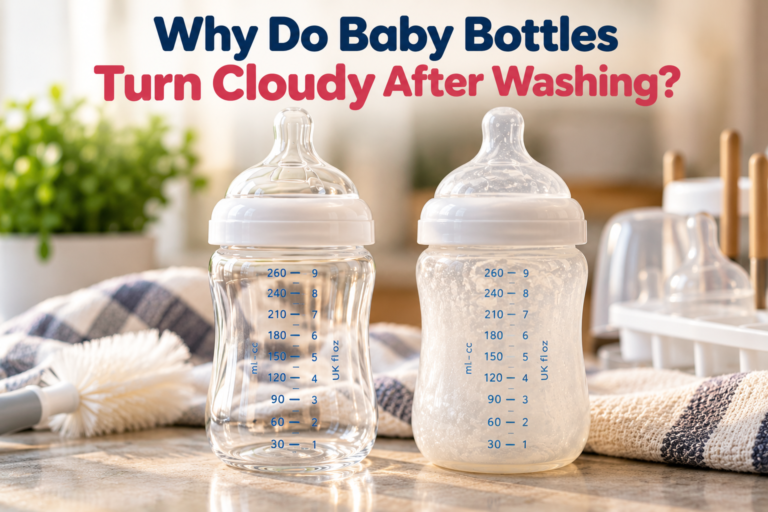
You finish washing your baby’s bottles, place them in the sterilizer, and wait for everything to dry. When you take them out, something looks wrong.
A thin white film covers the inside of one bottle. Another has cloudy streaks near the bottom. The silicone nipple looks slightly powdery, even though you cleaned it carefully.
You may wonder: Is it leftover formula? Minerals from hard water? Soap residue? Or something that could make your baby sick?
The confusing part is that different problems can leave surprisingly similar white marks on baby bottles.
Hard-water minerals can create a chalky coating. Milk fat and formula ingredients may leave residue if cleaning is incomplete. Dishwasher products can sometimes contribute to filming. Repeated washing may also make certain plastic bottles look cloudy without leaving a removable deposit.
And not every white mark means the bottle is unsafe.
The important thing is learning how to distinguish a removable film from damaged material or unexplained contamination.
This guide explores the questions parents ask about white bottle residue, including problems reported in parenting communities, and explains how to investigate them without relying on unsafe cleaning experiments.
Quick Answer: What Is the White Film Inside My Baby Bottle?
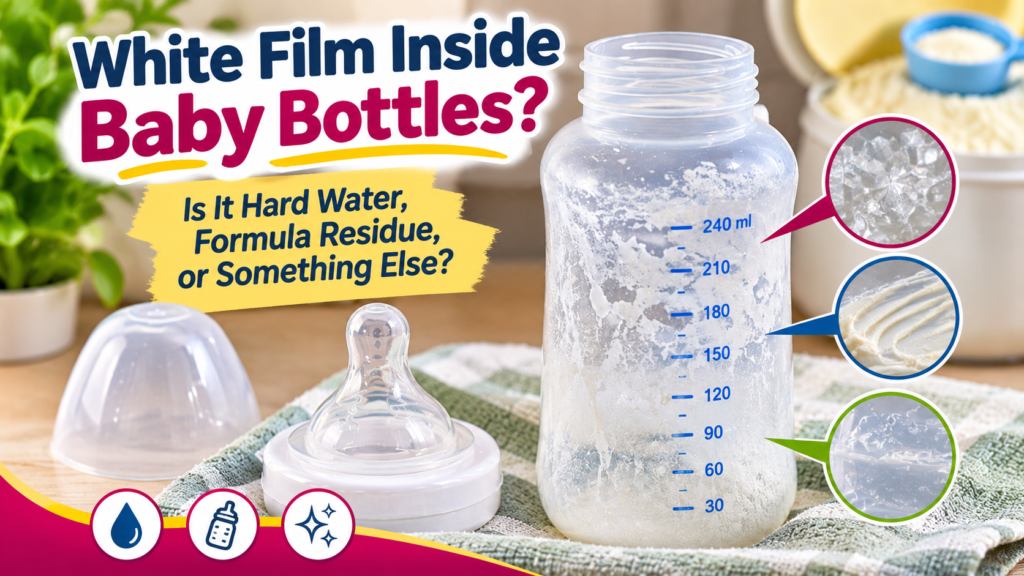
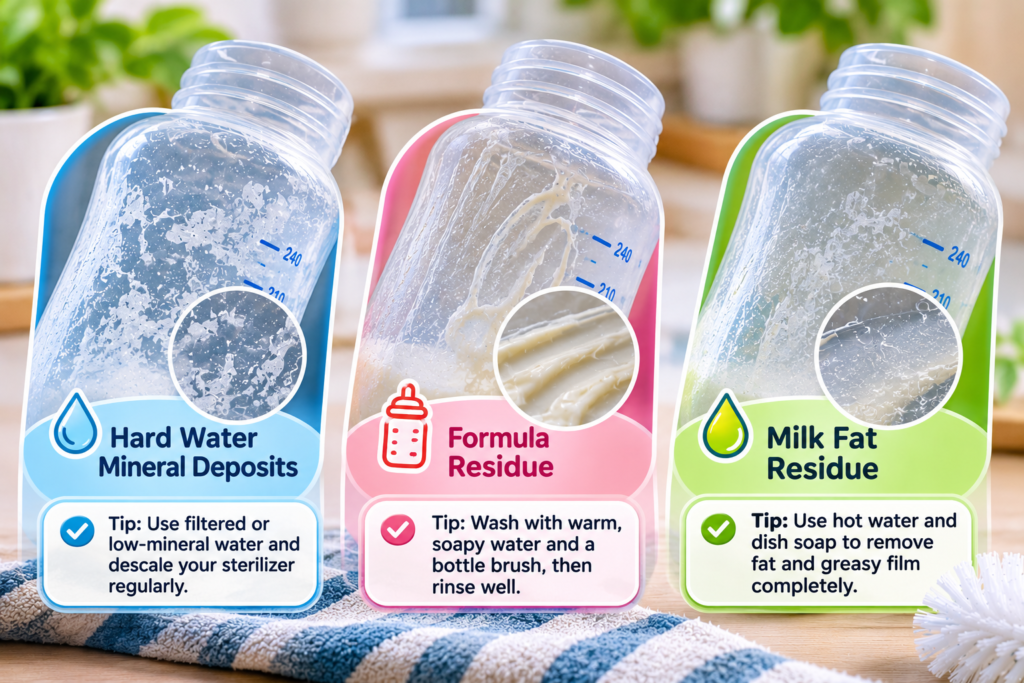
A white film inside a baby bottle is commonly associated with mineral deposits from hard water, leftover milk or formula residue, cleaning-product film, or changes in the bottle’s surface.
The most likely explanation depends on when the film appears, how it feels, where it collects, and whether it can be removed through proper washing.
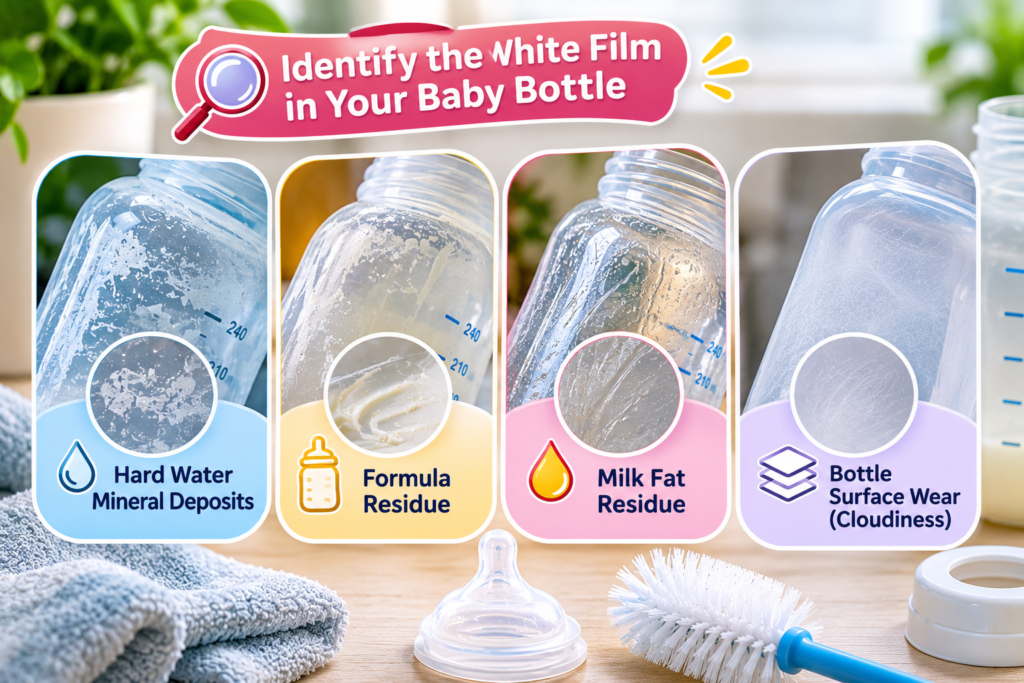
| What you notice | Possible explanation | First action |
|---|---|---|
| Dry, chalky white spots | Hard-water minerals | Check water and sterilizer |
| Greasy or slippery coating | Milk fat or inadequate rinsing | Rewash thoroughly |
| Milky streaks after formula feeding | Formula residue | Clean bottle base and corners |
| White marks after steam sterilizing | Mineral deposits | Check sterilizer maintenance |
| Cloudiness that cannot be washed away | Surface wear or staining | Inspect bottle condition |
| White film on several items after dishwasher use | Water or detergent-related filming | Check dishwasher and detergent |
| Fuzzy growth or unusual colored patches | Possible microbial contamination | Stop using the affected item |
These are clues, not laboratory tests. You cannot confirm the identity or safety of an unknown residue simply by looking at it.
1. Hard Water: A Common Reason for White, Chalky Bottle Residue
Hard water contains dissolved minerals, particularly calcium and magnesium.
When water evaporates, some of these minerals may remain on surfaces.
You may already recognize this effect from white deposits around a kettle, bathroom tap, or showerhead.
Baby bottles and sterilizers can develop similar deposits.
Why the film appears after sterilizing
Imagine washing a bottle until it looks completely clear.
You then place it inside a steam sterilizer. When the cycle finishes, you notice white spots that were not visible before.
One possible explanation is mineral-rich water used during the sterilizing process.
As water is heated and evaporates, mineral deposits can become more noticeable on the bottle or inside the appliance.
The result may look like:
- White dots on the bottle walls.
- A chalky ring near the bottom.
- Pale streaks after drying.
- Powdery deposits on compatible plastic components.
Does boiling make hard water disappear?
Boiling can reduce certain forms of temporary water hardness, but it does not remove all dissolved minerals.
In some situations, evaporation can make mineral deposits more concentrated.
This explains why repeatedly boiling a bottle in mineral-rich water may not eliminate the white coating.
Is hard-water residue dangerous for babies?
Ordinary calcium and magnesium deposits are not automatically dangerous. However, a white film should not be declared safe merely because it resembles limescale.
The safety of the water itself also matters.
Hardness is not the same as microbial or chemical water contamination. Water can be hard and otherwise suitable for drinking, or it can have other problems unrelated to mineral content.
If you cannot identify the film, clean the bottle again and investigate the water source before using it.
2. Formula Residue: Why a Bottle Can Look Clean but Still Have a White Coating
Infant formula contains proteins, fats, carbohydrates, minerals, and other nutrients.
After feeding, small amounts can remain attached to the inside of a bottle, particularly around corners, threads, and the base.
If the bottle is only rinsed, rather than properly washed, these residues may remain.
Why formula residue can be difficult to recognize
Not all leftover formula looks like dried milk.
Depending on the formula and cleaning conditions, residue may appear as a thin cloudy layer, a pale ring, or a slightly greasy coating.
A bottle may look clear when wet but reveal streaks after drying.
This does not prove the residue is formula, but it is worth considering when the film appears mainly on bottles used for formula feeding.
Why does the residue collect at the bottom?
The bottom of a bottle may have molded curves, ridges, or narrow areas that are harder to reach with a brush.
Formula can collect in these areas during feeding.
If the cleaning brush doesn’t reach them properly, residue may remain even after the rest of the bottle looks clean.
What to do
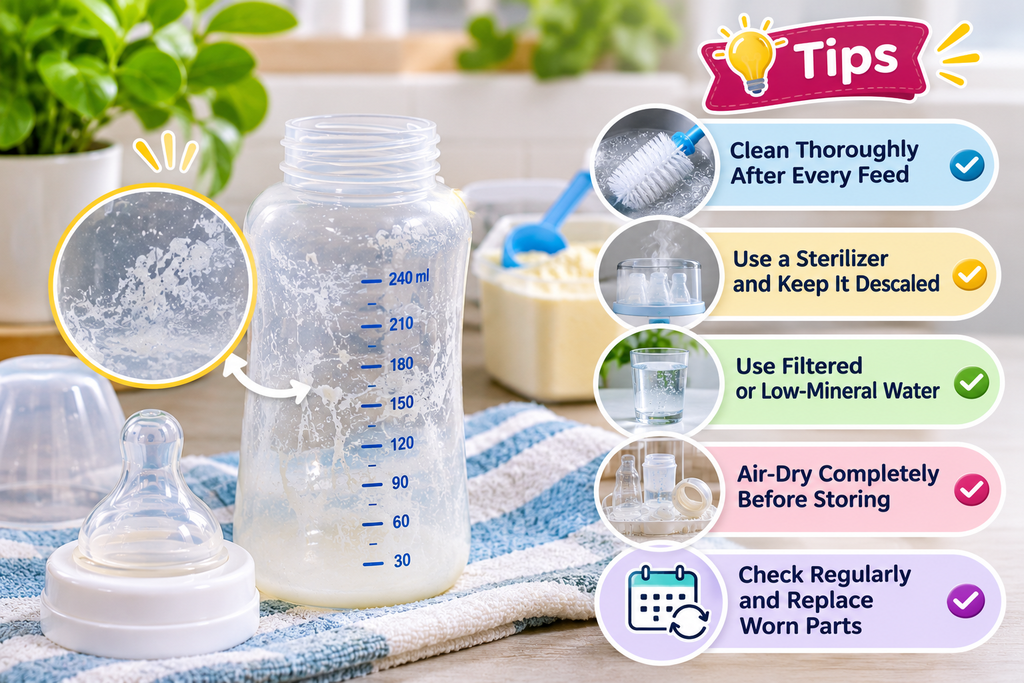
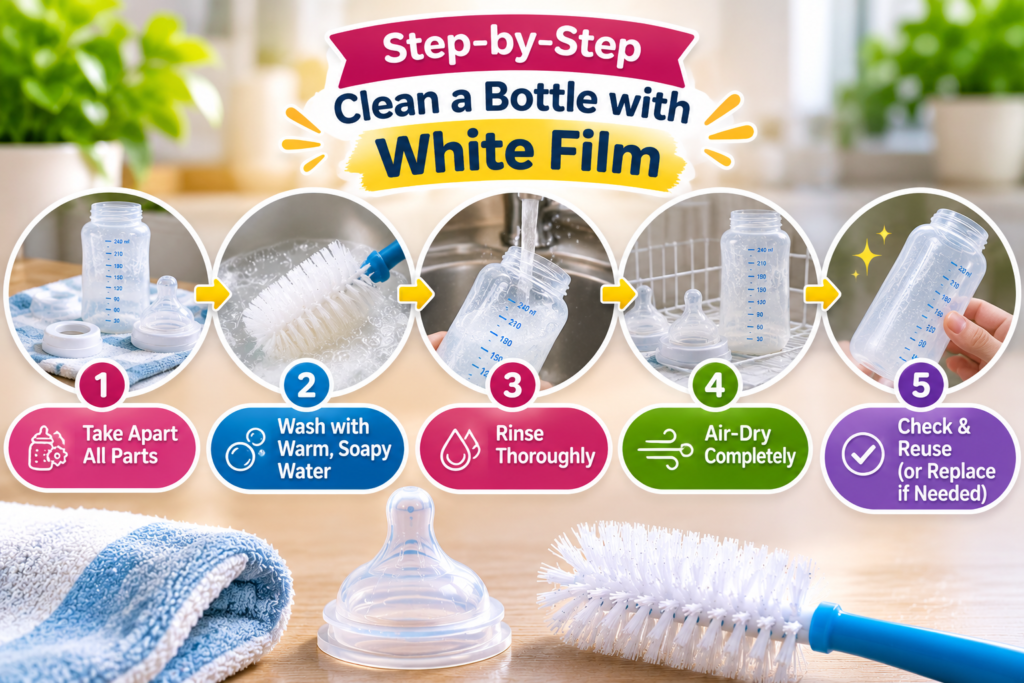
Disassemble the bottle and wash every milk-contact component with hot water and soap in a clean basin reserved for infant feeding items.
Use a clean bottle brush that reaches the base and internal corners. Rinse thoroughly under safe running water and allow everything to air-dry.
The CDC recommends cleaning bottles after every feeding rather than simply rinsing them, because germs can grow in leftover milk. CDC
Useful tip: Inspect the bottle base against a bright background after washing and drying. If a removable film remains, repeat the cleaning process before preparing another feed.
Read More: Why Do Silicone Baby Bottle Nipples Taste Like Soap?
3. Milk Fat vs Mineral Deposits: How Can Parents Tell the Difference?
This is one of the most useful distinctions because the two problems may require different preventive measures.
Milk contains fat, while hard water contains dissolved minerals.
Both can leave visible marks, but their physical characteristics may differ.
Milk-fat residue
Milk-fat residue may create a slippery or greasy feeling. It may also collect around the bottle neck, base, or other areas that are difficult to clean.
A thorough wash with appropriate dish soap should help remove ordinary milk-fat residue.
Mineral deposits
Mineral deposits are more likely to look dry, chalky, or powdery.
They may also appear on equipment that has not contained milk, such as the water reservoir of a sterilizer.
A better clue than appearance alone
Ask where the residue appears.
If a white coating develops inside an empty sterilizer water reservoir, milk fat is unlikely to be the explanation.
If the film appears only inside bottles after formula feeding, incomplete milk-residue removal becomes more plausible.
If it appears on clean bottles after a steam cycle, mineral deposits deserve closer investigation.
However, several causes can exist simultaneously.
A bottle might contain residual milk fat and also develop mineral spotting during sterilization.
4. Why Does White Film Appear Only After Steam Sterilizing?
Steam sterilization and washing perform different jobs.
Washing removes milk residue, grease, and other contamination.
Sanitizing reduces germs after the feeding equipment has been cleaned.
A steam sterilizer does not replace proper washing.
The CDC specifically recommends cleaning feeding items before sanitizing them. CDC
Possible reasons for white film after steam sterilization
Mineral-rich water: Dissolved minerals may leave deposits as water evaporates.
A sterilizer that needs descaling: Mineral buildup inside the appliance may contribute to recurring residue.
Incomplete bottle cleaning: Existing milk or detergent residue may become more noticeable after heating and drying.
Surface changes: Some bottle materials can develop persistent cloudiness over time.
The overlooked sterilizer question
If your bottles come out cloudy, check the sterilizer itself.
Look at its water reservoir and heating plate, if accessible according to the manufacturer’s instructions.
Do you see a chalky ring or pale crust?
If so, mineral buildup is a reasonable possibility.
Follow the manufacturer’s descaling instructions using only approved products and procedures.
Do not put household descaling chemicals directly into baby bottles unless the bottle manufacturer explicitly approves that cleaning method.
5. Why Does White Film Return Even After Descaling the Bottle Washer?
This is a real concern raised in parenting communities.
In an August 2026 discussion in r/beyondthebump, a parent reported white film returning to bottles and pumping equipment despite using descaling tablets and switching to filtered water. The parent was understandably reluctant to use the equipment while the cause remained unclear. Reddit
This highlights an important point: descaling does not fix every type of white residue.
If the film returns, consider several possibilities.
The water may still contain minerals
Not every household water filter is designed to remove dissolved hardness minerals.
A filter that improves taste or reduces certain contaminants may leave much of the calcium and magnesium in the water.
Check the filter’s certified claims rather than assuming that filtered water is soft water.
The detergent may be contributing
Dishwasher and automatic bottle-washer detergents have specific formulations.
Using the wrong product, incorrect quantity, or an incompatible cleaning cycle may contribute to residue.
Always follow the appliance and detergent manufacturers’ instructions.
The appliance may need additional maintenance
Some machines require cleaning of filters, spray components, or other removable parts.
A descaling cycle may address mineral buildup without correcting a blocked spray opening or poor rinsing performance.
The film may not be mineral residue
If repeated descaling makes no difference, the original assumption may be wrong.
Consider whether the marks are detergent-related, milk-related, or permanent surface cloudiness.
A useful troubleshooting sequence
Instead of repeatedly descaling the appliance, check the following:
- Inspect the appliance for mineral buildup and follow its maintenance instructions.
- Confirm that the detergent and dosage are correct.
- Check whether the water filter actually reduces hardness.
- Wash and dry a compatible bottle by hand using the CDC-recommended method.
- Compare the handwashed bottle with one cleaned in the machine.
If the film appears only after machine washing, investigate the machine, water, and detergent combination.
If both methods leave the same film, consider the bottle material and earlier exposure history.
This comparison can narrow down the possibilities, but it cannot certify that an unidentified residue is safe.
6. Why Does the Bottle Look Clear When Wet but White After Drying?
This pattern is particularly frustrating.
The bottle looks spotless under running water. Yet after sitting on the drying rack, a cloudy film becomes visible.
One possible explanation is mineral spotting.
When water is present, tiny surface deposits may be less noticeable. As the water evaporates, mineral residue can become easier to see.
However, drying can also reveal streaks left by incomplete rinsing or cleaning.
How to investigate
Observe whether the marks appear as isolated water spots or as a more uniform film.
Check whether similar marks develop on clean glassware washed with the same water.
Also inspect the bottle after a complete, proper cleaning cycle.
Do not assume that a film appearing only after drying must be harmless minerals.
If the residue is unexplained and remains after cleaning, set the bottle aside until you can identify the likely cause.
7. Why Does the White Film Appear on Silicone Nipples but Not on Glass Bottles?
Glass and silicone have different surface properties.
Glass is generally smooth and relatively resistant to odor absorption. Silicone is flexible and may interact differently with oils, fragrances, and other substances.
However, a white film on a silicone nipple could also result from dried mineral deposits, milk residue, or incomplete rinsing.
Look at the nipple’s shape
Bottle nipples have narrow openings, curved surfaces, and areas around the base that require careful cleaning.
Some anti-colic designs also include small valves or additional silicone components.
These areas may retain milk residue if the parts are not cleaned properly.
The CDC recommends squeezing soapy water through nipple openings during washing to ensure that the holes are cleaned. CDC
When to replace the nipple
Consider replacement if the nipple has:
- Cracks, tears, or damaged openings.
- Unusual stickiness or deterioration.
- Persistent unexplained residue.
- A strong chemical odor.
- Changes that affect its fit or function.
Follow the manufacturer’s replacement instructions.
If your silicone nipple also develops a detergent smell, see our related guide on why silicone baby bottle nipples may taste like soap.
8. White Film on Glass vs Plastic Baby Bottles: Does the Material Matter?
Yes, because not every cloudy appearance is caused by something sitting on the bottle’s surface.
Glass bottles
Glass is generally resistant to staining and scratching under normal use.
If a glass bottle develops a removable white coating after washing, water minerals or cleaning residue are reasonable possibilities to investigate.
However, glass can also develop persistent surface cloudiness under certain conditions.
If you notice chips, cracks, or other damage, stop using the bottle.
Plastic bottles
Plastic bottles can develop scratches and changes in surface appearance over time.
Repeated cleaning, mechanical wear, heat exposure, and contact with cleaning products may contribute to visible changes, depending on the material.
A bottle that looks cloudy may have a removable deposit, permanent surface wear, or both.
Can scratches trap milk residue?
Scratches and textured areas can be harder to clean thoroughly than smooth surfaces.
However, the presence of a scratch does not automatically mean that dangerous bacteria are present.
Inspect the bottle according to its manufacturer’s recommendations. Replace it if it is significantly damaged, deteriorated, or cannot be cleaned effectively.
Comparison
| Question | Glass bottle | Plastic bottle |
|---|---|---|
| Can hard water leave white spots? | Yes | Yes |
| Can milk residue remain? | Yes | Yes |
| Can the surface become scratched? | Yes | Yes |
| Can permanent cloudiness develop? | Possible | Possible |
| Is every white mark removable? | No | No |
| Should damaged bottles be replaced? | Yes | Yes |
Key takeaway: Don’t replace a bottle solely because it looks cloudy without first investigating the cause. But don’t continue using a damaged bottle just because it still holds milk.
9. Is the White Powder Inside Baby Bottles Mold?
A white or powdery appearance does not automatically indicate mold.
Mineral deposits and dried cleaning residue may look similar to some forms of contamination.
Mold can also appear in different colors and textures, so appearance alone is not enough to identify it.
Signs that deserve closer attention
- Fuzzy or irregular patches.
- Unusual colored spots.
- Visible growth around seals or valves.
- A persistent musty odor.
- Residue that repeatedly returns in difficult-to-clean areas.
If you suspect mold, stop using the affected component until it has been properly assessed, cleaned, or replaced.
For small, inexpensive components such as silicone valves and nipples, replacement may be more practical when contamination cannot be removed confidently.
Why moisture matters
Bottles stored while damp may provide conditions that support microbial growth.
The CDC recommends allowing feeding items to air-dry completely before storing them. It also warns that drying racks can retain moisture and require regular cleaning. CDC
An important distinction: sanitizing a dirty bottle does not replace removing visible contamination first.
10. Can White Film Be Caused by Too Much Dish Soap?
It is possible for cleaning-product residue or inadequate rinsing to contribute to a film.
However, you cannot identify detergent residue from color alone.
Dishwashing products contain different ingredients, and automatic dishwasher detergents are not interchangeable with handwashing liquids.
Common cleaning mistakes
Using more detergent than directed may make rinsing harder.
Washing bottles in a basin that already contains residue from other dishes can introduce additional contamination.
Failing to disassemble anti-colic valves, collars, or nipples may leave areas insufficiently cleaned.
What works better?
Use a clean basin dedicated to infant feeding equipment.
Follow the detergent’s usage instructions.
Scrub each component using an appropriate clean brush, then rinse thoroughly with safe running water.
Do not try to compensate for poor rinsing by repeatedly sterilizing the bottle.
If a bottle remains slippery or has an unexplained chemical smell after cleaning, do not use it until the problem is resolved.
11. Can a Baby Bottle Have Both Hard-Water Deposits and Formula Residue?
Yes.
This possibility is easy to overlook because parents often search for a single cause.
Imagine that a bottle contains a small amount of milk residue after washing.
It is then placed in a steam sterilizer that uses mineral-rich water.
After drying, the bottle may show a combination of deposits.
Some areas might look greasy, while others appear chalky.
Why this matters
If you focus only on removing minerals, the milk residue may remain.
If you focus only on washing away milk fat, the water spots may return after sterilizing.
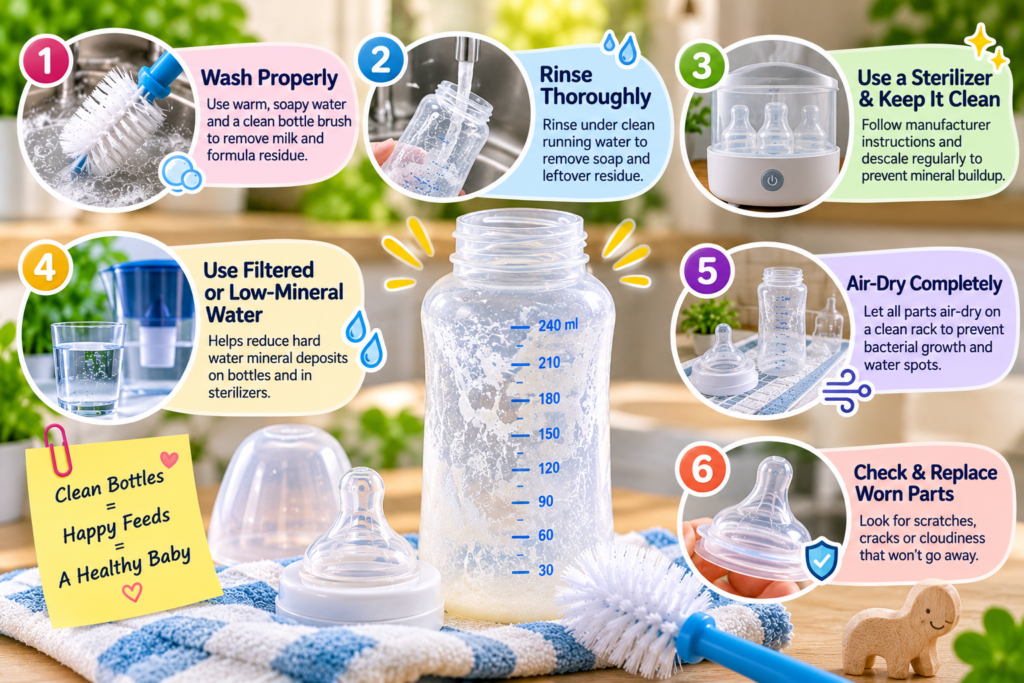
The better approach is to investigate each stage of the routine:
Follow the residue through your cleaning routine
Stage 1 — After feeding
Look for milk residue around the bottle base, neck, and nipple.
Stage 2 — After washing
Check whether visible residue remains after proper washing and rinsing.
Stage 3 — After sanitizing
Look for new chalky spots or marks that appear after the sterilizer cycle.
Stage 4 — After air-drying
Check whether white streaks become visible only after water evaporates.
The stage at which the film first appears can provide more useful information than its color alone.
12. Can Filtered, Boiled, or Distilled Water Prevent White Bottle Film?
These water types are not interchangeable.
Filtered water
Filtration performance depends on the system.
Some filters reduce chlorine-related tastes or certain contaminants without substantially reducing water hardness.
Check the filter’s certification and specifications.
Boiled water
Boiling can kill many disease-causing microorganisms, but it is not a universal method for removing dissolved minerals or chemical contaminants.
In particular, boiling does not make chemically contaminated water safe. CDC
Distilled water
Distilled water generally contains very low levels of dissolved minerals, making it useful for reducing mineral buildup in appliances designed to use it.
However, the water recommended for a sterilizer is not necessarily the water recommended for preparing infant formula.
Follow the sterilizer manufacturer’s instructions for appliance water.
For formula preparation, follow the formula manufacturer’s instructions and applicable public health guidance. Additional preparation precautions may be needed for babies at higher risk of infection. CDC
Never change your baby’s formula preparation method simply to prevent white marks inside the bottle.
13. Can Vinegar Remove White Film From Baby Bottles?
Vinegar is acidic and can dissolve certain mineral deposits, which is why it is commonly used for descaling household appliances.
But there is a difference between cleaning a kettle and cleaning equipment used to feed an infant.
Is vinegar a reliable way to identify hard-water deposits?
If an acidic descaler removes a deposit, that may be consistent with mineral buildup.
It does not prove that the deposit contained only calcium or magnesium, and it does not establish that the bottle is safe.
Should you soak baby bottles in vinegar?
Do not automatically apply household descaling recipes to baby bottles, nipples, or valves.
Only use vinegar or another descaling product on feeding equipment when the manufacturer explicitly approves the method, concentration, contact time, and rinsing procedure.
For an appliance, follow its dedicated descaling instructions.
Avoid mixing vinegar with bleach or other cleaning chemicals. Certain combinations can release hazardous gases.
When an unknown residue remains on a feeding component, replacing that component may be safer and simpler than experimenting with household chemicals.
14. How to Clean a Baby Bottle With White Film Safely
The safest starting point is a thorough cleaning routine supported by public health guidance.
Step 1: Disassemble every part
Remove the nipple, collar, cap, and any valves or membranes according to the manufacturer’s instructions.
Step 2: Wash in a dedicated basin
Wash your hands first. Rinse the parts, then clean them using hot water, dish soap, and a clean brush reserved for infant feeding equipment.
Step 3: Rinse thoroughly
Rinse each component with safe running water, paying attention to narrow areas and nipple openings.
Step 4: Allow complete air-drying
Place the cleaned components on a clean, unused dish towel or paper towel in a protected area. Do not rub them dry with a used kitchen towel.
Step 5: Inspect before reuse
Check for remaining film, damage, unusual odor, or hard-to-clean areas. If unexplained residue remains, set the component aside.
These cleaning steps follow CDC recommendations for infant feeding items. CDC
Should you sanitize afterward?
For extra germ removal, the CDC recommends daily sanitizing particularly when a baby is younger than two months, was born prematurely, or has a weakened immune system.
Daily sanitizing may not be necessary for older, healthy babies if feeding items are carefully cleaned after every use.
Use a sanitizing method approved for your equipment. CDC
15. When Should You Stop Using a Baby Bottle With White Film?
A white mark is not automatically a reason to discard an entire bottle.
However, there are situations where continuing to use it would be unwise.
Stop using the affected item until the problem is resolved if:
- The residue cannot be removed through proper cleaning and its cause remains unknown.
- You suspect mold or other contamination.
- The bottle is cracked, chipped, significantly scratched, or deteriorating.
- A silicone nipple is sticky, torn, or misshapen.
- The bottle has a persistent chemical odor.
- The cleaning appliance may be leaving an unknown substance on feeding equipment.
For an inexpensive nipple or valve that cannot be cleaned confidently, replacement may be the most practical decision.
If multiple bottles are affected, investigate the shared water source, detergent, and cleaning appliance before buying an entirely new set.
16. Frequently Asked Questions About White Film in Baby Bottles
These questions address specific problems parents encounter after washing, drying, and sterilizing feeding equipment.
Why does my baby bottle have white powder after sterilizing?
White powder after sterilizing may be mineral residue left by evaporating water, especially if the sterilizer uses hard water. Check the sterilizer’s reservoir and maintenance instructions. Do not assume that every powdery deposit is harmless.
Is white film inside a baby bottle harmful?
Not necessarily. Ordinary mineral deposits are different from detergent residue, microbial contamination, or damaged plastic. Because appearance alone cannot establish what the film contains, properly clean and inspect the bottle before reuse.
Why does my baby bottle look cloudy after boiling?
Mineral deposits, existing residue, or changes in the bottle material may contribute. Check whether the cloudiness can be removed through approved cleaning and whether the bottle is suitable for boiling.
Why do Dr. Brown’s or other anti-colic bottles develop white residue?
Anti-colic systems often include extra vents, tubes, or valves. These components may require more detailed cleaning, and mineral deposits can also form on them. Follow the specific manufacturer’s disassembly and cleaning instructions.
Why does the white film appear only on the bottom of the bottle?
The bottom may collect milk residue because of its shape, or water droplets may dry there and leave minerals. The location alone cannot confirm the cause.
Can formula powder cause a chalky layer inside bottles?
Formula ingredients may leave residue when cleaning is incomplete. However, a chalky layer can also be caused by water minerals. If the film remains after proper cleaning, investigate other possible sources.
Why does my bottle washer leave white marks even with filtered water?
Some filters do not significantly reduce water hardness. Detergent dosage, rinsing performance, appliance maintenance, and existing surface wear may also contribute.
Can I use a baby bottle with a few white water spots?
If the marks are confirmed to be ordinary mineral deposits and the bottle is otherwise clean, intact, and suitable for use, they are not necessarily a reason to discard it. If the source is uncertain, clean and investigate the bottle before feeding.
Can white film inside baby bottles be bacteria?
Bacteria generally cannot be reliably identified by looking for a white film. Visible residue is not a dependable test for bacterial contamination. Proper cleaning and appropriate sanitizing remain important even when a bottle looks clear.
Why does my bottle turn white after the dishwasher?
Possible explanations include hard-water deposits, detergent-related filming, or surface changes. Check that the bottle is dishwasher-safe and that the detergent and cycle are appropriate.
Should I replace a cloudy plastic baby bottle?
Not always. First determine whether the cloudiness is removable residue or a change in the plastic itself. Replace bottles that are damaged, deteriorating, or cannot be cleaned effectively.
Does using distilled water stop white film completely?
Low-mineral water may reduce mineral spotting in compatible sterilizers, but it cannot prevent milk residue, detergent-related film, or surface deterioration. Follow the appliance manufacturer’s water recommendations.
Why does the white film disappear when the bottle is wet?
Water may temporarily make certain deposits or surface imperfections less visible. When the water evaporates, the marks can become noticeable again. This is a clue, not a reliable identification test.
Is it normal for silicone bottle nipples to look cloudy?
Some silicone components change in appearance with use, but persistent film, unusual texture, or deterioration should be investigated. Follow the manufacturer’s care and replacement instructions.
17. A Practical Decision Guide: What Should You Do Next?
Identify Your Bottle’s White Film
Select the observation that best matches your situation.Dry, chalky white spotsGreasy or slippery white coatingWhite marks appear after sterilizingPermanent-looking cloudy plasticUnknown residue, odor, or possible growth
Investigate hard-water minerals
Check whether similar deposits appear in your sterilizer or on other clean items. Follow appliance descaling instructions and thoroughly clean the bottle. Do not use an unexplained residue-covered bottle.This guide helps narrow down possibilities; it cannot diagnose the residue or certify feeding equipment as safe.
Final Thoughts: A White Film Does Not Always Mean a Dirty Baby Bottle
Finding white residue inside a freshly washed baby bottle can be worrying, particularly when the same marks keep returning.
But white film is not one single problem.
It may be mineral buildup from hard water, milk or formula residue, detergent-related filming, or changes in the bottle’s material.
The most useful question is not simply, “How do I remove this white film?”
It is “At what point in my cleaning routine does this film appear, and what could be causing it?”
If the marks appear after sterilizing, investigate the water and appliance. If they appear after feeding, review the washing process. If the bottle remains cloudy after correct cleaning, inspect its material condition.
Avoid aggressive cleaning experiments and don’t rely on appearance alone to judge safety.
A consistent routine of thorough washing, proper rinsing, complete air-drying, and appropriate sanitizing is the best foundation for keeping baby feeding equipment hygienic.
When a component remains damaged, contaminated, or impossible to clean confidently, replacing it is a sensible decision.
Sources and further reading
This article draws on established public health recommendations and uses parenting discussions to identify practical questions, not to establish medical facts.
- CDC — How to Clean, Sanitize, and Store Infant Feeding Items
- CDC — Infant Feeding Equipment Cleaning FAQs
- CDC — Infant Formula Preparation and Storage
- Reddit — Parent Discussion About Recurring White Film in a Bottle Washer
- Reddit — White Powdery Residue After Cleaning Baby Bottles
Editorial note: This article provides educational information, not a laboratory identification method or individualized medical advice. Reddit experiences are anecdotal. A qualified pediatric or infant-feeding professional should review safety-sensitive content before publication.