16 min readUpdated November 1, 2026
What this guide covers
- Quick Answer: Why Does My Baby Bottle Nipple Taste Like Soap?
- 1. Why Silicone Can Hold Onto Dish Soap Smells
- 2. Why Does the Silicone Nipple Smell Like Soap but the Bottle Doesn’t?
- 3. Why Does My Baby Bottle Nipple Smell Worse After the Dishwasher?
- 4. Can Dish Soap Make a Baby Refuse a Bottle?
- 5. The New-Nipple Comparison: A Better Way to Troubleshoot
- A simple comparison checklist
- 6. Is Fragrance-Free Dish Soap Better for Baby Bottles?
- 7. Can You Remove the Soap Taste From Silicone Nipples?
- 8. Why Boiling the Nipple Again May Not Solve the Problem
- 9. Why Does the Nipple Smell Fine When Dry but Soapy When Wet?
- 10. Does Breast Milk or Formula Make Silicone Smell Like Soap?
- 11. When Should You Replace a Silicone Baby Bottle Nipple?
- 12. How to Prevent Soap Smells From Coming Back
- 13. What Parents Should Avoid When Trying to Remove Silicone Odors
- 14. Frequently Asked Questions
- Final Thoughts: Don’t Ignore a Persistent Soap Smell, but Don’t Panic Either
- Further reading
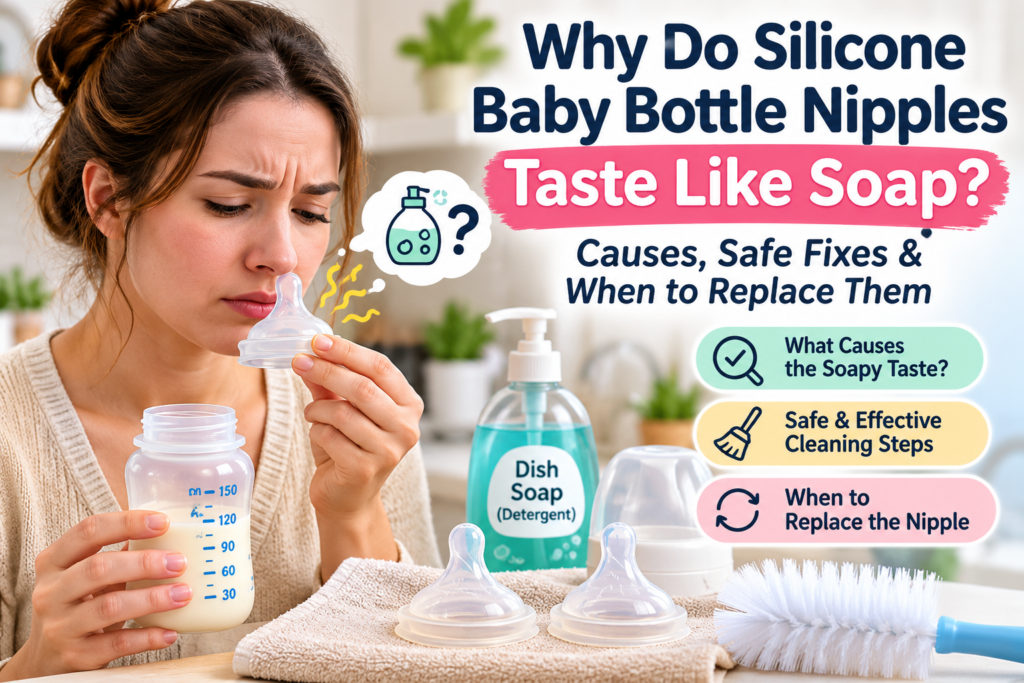
A practical guide for parents dealing with soapy-smelling bottle nipples, detergent flavors, and babies suddenly refusing a familiar bottle.
You wash your baby’s bottle carefully, rinse every part, and leave everything to dry. The bottle looks perfectly clean.
But when you pick up the silicone nipple, something seems wrong.
It smells like dish soap.
Maybe you notice the fragrance immediately. Or perhaps your baby suddenly pushes away a bottle they normally accept, leaving you wondering whether the nipple tastes different.
You wash it again, but the smell remains.
This situation raises several questions: Can silicone absorb dish soap fragrance? Does the dishwasher make it worse? Can a nipple smell clean but still affect the taste of milk? And, most importantly, is it safe to keep using?
The answers aren’t always straightforward.
Silicone is widely used in baby feeding products because it is flexible, durable, and suitable for food contact when properly manufactured and used. However, some silicone products can retain odors or flavor-related compounds, particularly after contact with scented cleaning products.
A soapy smell does not automatically mean a nipple is contaminated or unsafe. But a persistent chemical taste, visible residue, damaged material, or unexplained feeding difficulty deserves attention.
This guide explains how to investigate the problem without relying on questionable cleaning hacks or repeatedly boiling a nipple that may simply need replacing.
Quick Answer: Why Does My Baby Bottle Nipple Taste Like Soap?
Silicone baby bottle nipples may develop a soapy smell or taste after repeated contact with fragranced dishwashing liquids, dishwasher detergents, or other odor-producing substances. The smell may persist after rinsing because certain compounds can remain associated with the silicone surface or material.
However, not every soapy odor comes from absorbed fragrance. Inadequate rinsing, trapped detergent around the nipple base, or residue inside a valve may also be responsible.
Start by cleaning and thoroughly rinsing the nipple according to its manufacturer’s instructions. If the odor persists, compare it with a new, compatible nipple and consider replacing the affected part.
Do not use the nipple if it has visible damage, unusual stickiness, or a persistent chemical smell that you cannot identify.
1. Why Silicone Can Hold Onto Dish Soap Smells
Silicone is not the same material as glass or hard plastic.
Its flexible structure makes it useful for bottle nipples, pacifiers, and feeding accessories. But silicone’s interaction with some odor-producing substances can differ from that of glass.
Some fragrance-related compounds may remain associated with silicone even after the product has been washed.
This helps explain why a glass bottle can smell neutral while its silicone nipple still smells like lemon, flowers, or dishwashing liquid.
Is the silicone actually absorbing soap?
That depends on what you mean by soap.
Dishwashing liquid contains multiple ingredients, including cleaning agents and, in scented products, fragrance compounds.
A lingering fragrance does not necessarily mean a harmful amount of detergent remains on the nipple.
Similarly, the absence of a smell does not prove that an item has been cleaned properly.
The important distinction is between three possibilities:
- Fragrance retention: The nipple continues smelling like the detergent even after thorough rinsing.
- Cleaning-product residue: Some cleaning product remains on or around the nipple.
- An unrelated odor: Milk residue, storage conditions, or material deterioration is responsible.
These situations may require different responses.
An overlooked detail
Parents sometimes change their dish soap because it cleans bottles more effectively or smells pleasant.
But a stronger fragrance can make it harder to distinguish the smell of a cleaning product from the smell of the nipple itself.
If you’re dealing with repeated odor problems, a fragrance-free dishwashing product may make troubleshooting easier.
Fragrance-free does not mean cleaning is optional. You still need to wash, rinse, and dry every component properly.
2. Why Does the Silicone Nipple Smell Like Soap but the Bottle Doesn’t?
This is one of the clearest clues that the issue may be material-specific.
Consider a bottle made from glass with a silicone nipple and a plastic collar.
After washing, the glass body smells neutral, the plastic collar has little or no odor, but the silicone nipple smells strongly of detergent.
All three components were washed using the same cleaning product.
Why the difference?
Different materials interact differently with fragrances, oils, and other substances.
Glass is generally less prone to retaining odors than some flexible polymer materials. Silicone’s behavior depends on its formulation, manufacturing, age, and the substances it contacts.
However, the nipple may also have small areas around its base that require careful cleaning and rinsing.
How to investigate
After washing and drying the parts according to the manufacturer’s instructions, inspect them separately.
Compare the odor of the bottle body, collar, nipple, and any valves.
If only the nipple smells, concentrate on its material, condition, and cleaning history rather than replacing the entire bottle.
This is a practical comparison, not a validated test for chemical contamination.
3. Why Does My Baby Bottle Nipple Smell Worse After the Dishwasher?
Some parents notice that silicone nipples smell normal after handwashing but develop a strong detergent fragrance after dishwasher cleaning.
A dishwasher exposes feeding equipment to a different combination of cleaning products, water temperature, rinsing conditions, and drying methods.
Possible explanations include:
Dishwasher detergent: A different detergent formulation may leave a more noticeable fragrance.
Rinse performance: Detergent can remain in poorly rinsed areas if components are incorrectly positioned or obstructed.
Small component design: Nipples, valves, and collars have openings and surfaces that require thorough cleaning.
Existing odor retention: A nipple may already have a lingering fragrance that becomes more noticeable after washing.
These are possible explanations, not proof that dishwashers cause silicone to absorb harmful amounts of detergent.
Does this mean you should stop using the dishwasher?
Not necessarily.
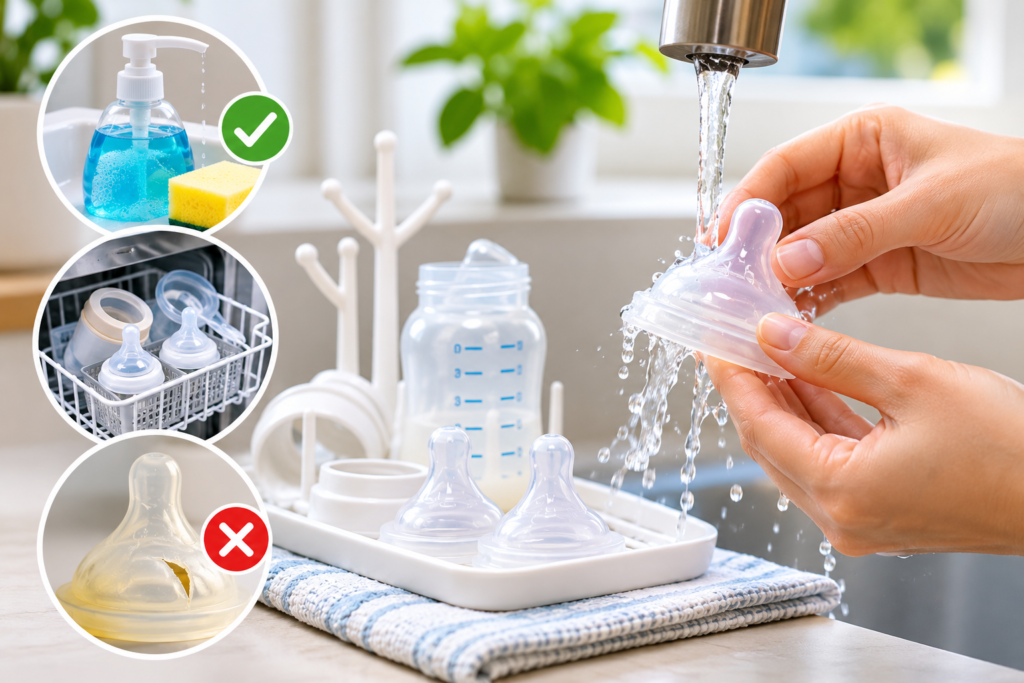
The CDC supports dishwasher cleaning for infant feeding items that are labeled dishwasher-safe. It recommends disassembling the parts, rinsing them, securing small items in an appropriate basket, and using a hot-water and heated-drying or sanitizing setting when possible. CDC
If the manufacturer approves dishwasher use but a particular detergent consistently leaves a strong odor, try a different compatible cleaning product.
If the problem continues, consider handwashing the nipple according to the manufacturer’s instructions.
Do not assume that all silicone nipples can tolerate every dishwasher setting.
4. Can Dish Soap Make a Baby Refuse a Bottle?
A baby may reject a bottle for many reasons, including changes in feeding flow, temperature, positioning, illness, or feeding preferences.
A noticeable change in nipple odor or taste is another possibility worth investigating.
In a Reddit discussion about silicone feeding products, parents described lingering soap flavors and one reported bottle refusal associated with a dishwasher-washed nipple. Reddit
That observation is useful, but it doesn’t establish that detergent fragrance caused the refusal.
What parents can check first
Suppose your baby normally accepts a particular bottle but suddenly becomes upset when feeding begins.
Ask yourself:
- Did you recently change dish soap or dishwasher detergent?
- Did you start using a new dishwasher cycle?
- Is the nipple visibly damaged or unusually sticky?
- Has the nipple flow rate changed?
- Does a new, compatible nipple smell different?
If the existing nipple has an unexplained persistent odor, stop using it while you investigate.
A new nipple of the same brand, size, and flow rate may help eliminate one possible equipment issue.
Never force a baby to continue feeding with a bottle they are repeatedly rejecting.
If your baby is taking substantially less milk, has fewer wet diapers, seems unusually sleepy, or shows signs of dehydration, seek prompt medical advice.
5. The New-Nipple Comparison: A Better Way to Troubleshoot
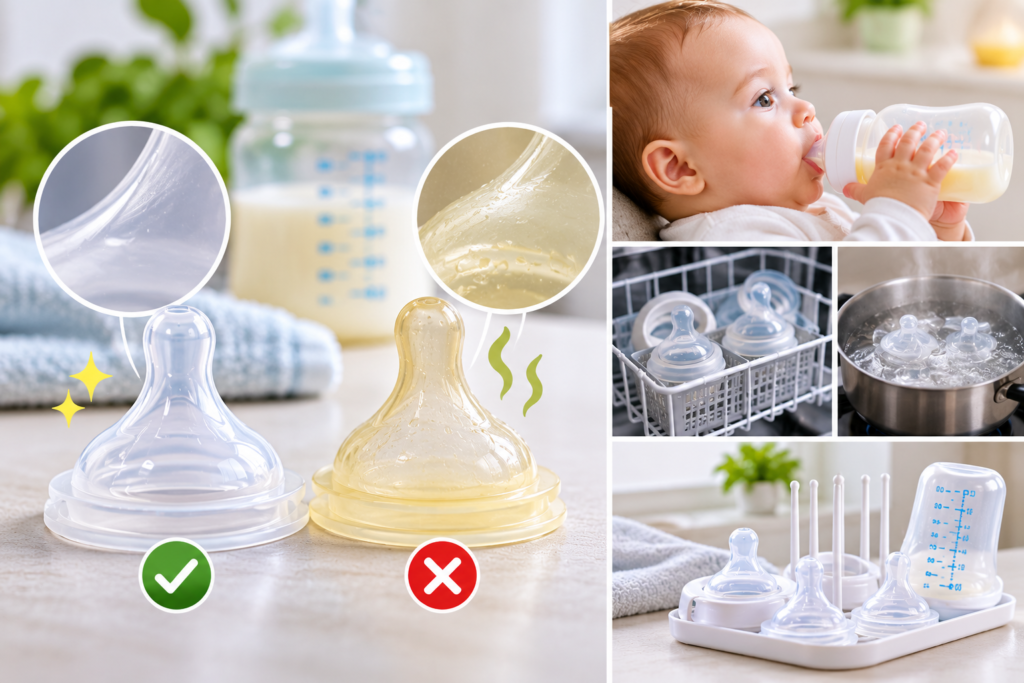
Instead of repeatedly washing every bottle in the house, compare the affected nipple with an unused, compatible replacement.
This can help narrow down the source of the odor.
A simple comparison checklist
Check both nipples for visible damage or unusual textureCompare odors without adding milk or cleaning chemicalsReview whether the old nipple has been exposed to scented detergentsCheck the manufacturer’s cleaning and replacement instructionsSet aside any nipple with unexplained persistent odor or damage
0 of 5 checkedReset
How to interpret what you notice
If the old nipple smells strongly of detergent but the unused nipple does not, the difference may relate to cleaning exposure, aging, or material condition.
If both nipples smell similar, consider whether you’re noticing the material’s normal odor or something related to storage and packaging.
Neither observation can establish chemical safety.
The comparison is intended to guide your next step, not certify that a nipple is safe for feeding.
6. Is Fragrance-Free Dish Soap Better for Baby Bottles?
Fragrance-free dish soap can be a sensible choice when you’re trying to eliminate lingering detergent smells.
It removes an unnecessary source of fragrance from the cleaning routine.
However, fragrance-free soap is not automatically safer or more effective than every scented alternative.
What matters is that the product is appropriate for washing feeding equipment, is used as directed, and can be thoroughly rinsed away.
Fragrance-free versus unscented
These labels do not always mean the same thing.
A product described as unscented may contain ingredients used to mask its natural odor, depending on the formulation.
A product labeled fragrance-free generally indicates that fragrance ingredients have not been intentionally added, although labeling standards vary by country.
If you’re concerned about a particular ingredient, check the product’s ingredient information rather than relying only on the front label.
Practical tip
When investigating a persistent soap smell, change one variable at a time.
For example, keep the bottle, cleaning method, and drying routine the same while switching to a suitable fragrance-free detergent.
Changing five things simultaneously may solve the problem, but it won’t tell you what caused it.
7. Can You Remove the Soap Taste From Silicone Nipples?
Sometimes a lingering odor disappears after correct washing and thorough rinsing.
In other cases, it remains despite careful cleaning.
There is no universal household treatment proven to remove every fragrance compound from every silicone nipple.
The safest first approach
- Wash your hands before handling feeding equipment.
- Disassemble the bottle completely.
- Wash the nipple in a dedicated clean basin with hot water and appropriate dish soap.
- Clean the nipple thoroughly, including the opening, following the manufacturer’s directions.
- Rinse completely using safe running water.
- Allow it to air-dry thoroughly in a clean area.
The CDC recommends these basic steps for cleaning infant feeding items after each use. CDC
If the nipple still has a strong, unexplained detergent or chemical odor, replacing it is more sensible than experimenting with increasingly aggressive treatments.
What about vinegar and baking soda?
Vinegar and baking soda are frequently suggested online for removing silicone odors.
But there is an important distinction between deodorizing household silicone cookware and treating a nipple that a baby will suck on repeatedly.
Neither vinegar nor baking soda should be assumed to sanitize feeding equipment or remove potentially harmful chemical residues.
Only use additional cleaning treatments if the nipple manufacturer specifically permits them.
Avoid essential oils, perfumes, solvents, abrasive cleaners, or improvised chemical mixtures.
8. Why Boiling the Nipple Again May Not Solve the Problem
Boiling is an accepted sanitizing method for suitable infant feeding equipment, but it is not a guaranteed solution for persistent fragrance.
Cleaning and sanitizing have different purposes.
Cleaning removes milk residue and other contamination.
Sanitizing reduces germs after cleaning.
The CDC advises cleaning first, then sanitizing as needed using a manufacturer-compatible method. For boil-safe feeding items, its sanitizing instructions specify boiling disassembled parts for five minutes. CDC
However, repeated boiling beyond manufacturer recommendations is not a reliable method for removing detergent odors.
If a nipple is damaged, sticky, cracked, or persistently smells chemical-like, further boiling should not be used to justify continued use.
Replacement may be the safer and simpler option.
9. Why Does the Nipple Smell Fine When Dry but Soapy When Wet?
This is a particularly confusing situation.
You remove a nipple from the drying area, and it smells normal. Later, while preparing a bottle, you notice a familiar detergent fragrance.
Why would the smell become noticeable again?
Several explanations are possible.
First, moisture or warmth may change how noticeable certain odor-producing compounds are. Second, a small amount of residue in a fold or around the nipple base may become more apparent when wet. Third, the odor may be coming from another bottle component rather than the nipple.
However, there is limited direct research establishing exactly how common this pattern is in baby bottle nipples.
How to investigate without risking a feed
Clean the nipple according to the manufacturer’s instructions and allow it to dry completely.
Then inspect it again before using it.
If the smell is persistent, unusual, or chemical-like, set it aside rather than preparing milk in it.
A useful prevention habit is to check clean feeding equipment before filling it, not after you’ve already prepared a bottle.
This can prevent unnecessary milk waste and make equipment problems easier to identify.
10. Does Breast Milk or Formula Make Silicone Smell Like Soap?
A soapy odor does not always originate from dishwashing liquid.
Sometimes parents notice an unusual smell in expressed breast milk itself.
Stored breast milk can develop a soapy or metallic odor associated with changes in milk fat, including lipase activity. This is a different issue from a silicone nipple retaining detergent fragrance.
Formula can also develop unpleasant odors if prepared, handled, or stored incorrectly.
How can you tell the difference?
Consider where the odor is noticeable.
| Observation | What to investigate |
|---|---|
| Empty nipple smells like detergent | Nipple and cleaning routine |
| Empty bottle and nipple smell normal, but stored breast milk smells soapy | Breast milk handling and storage |
| Formula smells unusual before entering the bottle | Formula preparation, product condition, and storage |
| Only one bottle has an odor | Individual bottle components |
| Multiple bottles develop the same smell after washing | Shared detergent or cleaning process |
These are investigative clues, not definitive safety tests.
Never taste questionable milk to decide whether it is safe. Smell alone also cannot reliably establish whether breast milk or formula is safe to feed.
Follow established milk storage and formula preparation guidance, and discard milk that may have been improperly handled.
For more general causes of bottle odors, read our guide: Why Baby Bottles Smell Bad Even After Washing.
11. When Should You Replace a Silicone Baby Bottle Nipple?
A silicone nipple does not have to look completely worn out before replacement becomes appropriate.
Follow the manufacturer’s replacement schedule and inspect nipples regularly.
Signs that replacement is the better choice
The nipple has a tear, crack, or damaged opening.
The material has become unusually sticky, brittle, or misshapen.
The nipple no longer fits or functions as intended.
A strong chemical odor persists despite correct cleaning.
The manufacturer recommends replacement based on age or usage.
Do not enlarge nipple holes yourself or attempt to repair damaged silicone with adhesives.
Use replacement nipples specifically compatible with your bottle system.
Do you need to replace the whole bottle?
Not necessarily.
If the bottle body is undamaged, functions correctly, and has no unexplained odor, replacing the affected nipple may be sufficient.
This can save money and reduce unnecessary waste.
However, inspect all parts, including collars and valves, before deciding.
12. How to Prevent Soap Smells From Coming Back
The best prevention strategy is a cleaning routine that minimizes residue, protects the nipple material, and allows every part to dry completely.
After every feeding
Disassemble the bottle and clean all milk-contact parts.
The CDC recommends washing infant feeding items after each use, including nipples, rings, caps, and valves. CDC
Use a dedicated clean washing basin rather than placing feeding equipment directly in the kitchen sink.
Rinse thoroughly and allow the parts to air-dry.
When choosing detergent
Consider a fragrance-free dishwashing liquid if your current product leaves noticeable scents.
Use an appropriate amount according to the detergent instructions. More detergent does not necessarily mean cleaner bottles.
When using a dishwasher
Confirm that the nipple is dishwasher-safe.
Secure small components in a suitable basket, follow the manufacturer’s placement instructions, and inspect the parts after the cycle.
Before storing
Ensure that the nipple, collar, and other components are completely dry.
The CDC recommends storing dry feeding equipment in a clean, protected location to help prevent contamination. CDC
Weekly inspection
Set aside a few minutes to check for material changes, damaged openings, and unusual odors.
Pay attention to components that are repeatedly exposed to high temperatures or cleaning products.
This small habit can help you identify wear before the next feeding.
13. What Parents Should Avoid When Trying to Remove Silicone Odors
A stubborn smell can make repeated cleaning experiments tempting.
But not every household cleaning trick is suitable for infant feeding equipment.
Avoid using concentrated fragrance products to cover an odor. Do not use essential oils or perfume on bottle nipples.
Avoid abrasive scrubbing that could damage the silicone.
Do not soak nipples in household chemicals unless the manufacturer or a recognized public health authority provides an appropriate method.
Do not repeatedly expose a nipple to temperatures beyond its approved limits.
And never continue using visibly damaged feeding equipment simply because the odor has disappeared.
A nipple that no longer smells bad is not necessarily safe if its material has deteriorated.
14. Frequently Asked Questions
Why do silicone baby bottle nipples taste like dish soap?
A lingering soap-like taste or smell may be associated with fragrance compounds, inadequate rinsing, or residue around the nipple. Correct cleaning and thorough rinsing are the first steps. Replace a nipple with a persistent unexplained chemical odor.
Can silicone baby bottle nipples absorb detergent fragrance?
Some silicone materials can retain odor-producing substances. The extent depends on the silicone formulation, cleaning product, exposure, and other factors. A lingering fragrance does not, by itself, establish that harmful detergent residue is present.
Can dishwasher detergent make baby bottle nipples taste bad?
Parents report this experience, and it is plausible that detergent fragrance or inadequate rinsing could contribute. However, the specific cause cannot be confirmed from smell alone.
Will switching to fragrance-free dish soap solve the problem?
It may help prevent new fragrance-related odors. It cannot guarantee removal of an odor already retained by an older nipple.
Is a soapy-smelling baby bottle nipple toxic?
A soapy smell alone cannot determine toxicity. If you suspect actual detergent contamination, rinse and clean the nipple properly. If there has been a significant cleaning-product exposure, or your baby develops symptoms, contact a healthcare professional or poison control service promptly.
Why does only one nipple smell like soap?
That nipple may have experienced different cleaning exposure, wear, storage conditions, or material changes. Inspect it separately and compare it with an unused compatible replacement.
Can I use baking soda to remove soap smell from baby bottle nipples?
Do not assume baking soda is appropriate for every nipple. Follow the manufacturer’s cleaning instructions, and remember that baking soda is not a substitute for proper washing and sanitizing.
Does sterilizing remove detergent from silicone?
Sanitizing is intended to reduce germs, not to replace washing and rinsing. A nipple should be properly cleaned before sanitizing.
Can soap taste make a baby refuse a bottle?
A change in nipple odor or taste could be one factor, but bottle refusal has many possible causes. If feeding difficulties continue, consult your baby’s healthcare professional.
Should I buy glass bottles to avoid soap smells?
Glass bottle bodies may retain fewer odors than some other materials, but most glass feeding bottles still use silicone nipples. Changing the bottle body alone may not resolve a nipple-related odor.
Final Thoughts: Don’t Ignore a Persistent Soap Smell, but Don’t Panic Either
Discovering a detergent smell on your baby’s bottle nipple can be unsettling, especially when you’ve already cleaned it carefully.
But the smell doesn’t automatically mean you’ve done something wrong or that the nipple contains a dangerous amount of detergent.
The most useful approach is to identify which component smells, review your cleaning products, check the nipple’s condition, and follow the manufacturer’s care instructions.
A fragrance-free detergent may help reduce recurring odors. Thorough rinsing and drying can help prevent residue and moisture problems.
If a nipple remains strongly scented, smells chemically unusual, or shows signs of deterioration, replacing that individual component is often a practical solution.
The goal is not to make every nipple last as long as possible. It’s to keep feeding equipment clean, functional, and appropriate for your baby’s needs.
Further reading
- CDC — How to Clean, Sanitize, and Store Infant Feeding Items
- CDC — Infant Feeding Equipment Cleaning FAQs
- Reddit — Parents Discuss Soapy Silicone Feeding Products
Editorial note: This article provides general educational information. Reddit comments are used to identify parent concerns, not as clinical evidence. The troubleshooting suggestions have not been presented as personally tested methods. Medical and product-safety review is recommended before publication.