17 min readUpdated November 5, 2026
What this guide covers
- Quick Answer: Why Does a Baby Bottle Nipple Collapse?
- What Actually Happens Inside the Bottle When the Nipple Collapses?
- 9 Reasons Your Baby Bottle Nipple Keeps Collapsing
- The 60-Second Bottle Nipple Troubleshooting Check
- Why a Faster-Flow Nipple Sometimes Makes the Problem Worse
- What If the Nipple Collapses but Your Baby Seems Perfectly Happy?
- What If the Bottle Nipple Collapses After Every Sterilizing Cycle?
- Why Does My Baby Bottle Nipple Collapse at Night but Not During the Day?
- Can a Collapsing Nipple Cause Gas, Reflux, or Colic?
- Should You Loosen the Bottle Ring to Release the Vacuum?
- Should You Make the Nipple Hole Bigger?
- How to Clean Bottle Nipples and Valves Without Damaging Them
- When Is a Collapsing Bottle Nipple a Reason to Contact a Doctor?
- Frequently Asked Questions
- Final Thoughts: Watch the Feeding Pattern, Not Just the Nipple
- Related Reading on GetBabyInfo
- Trusted Sources
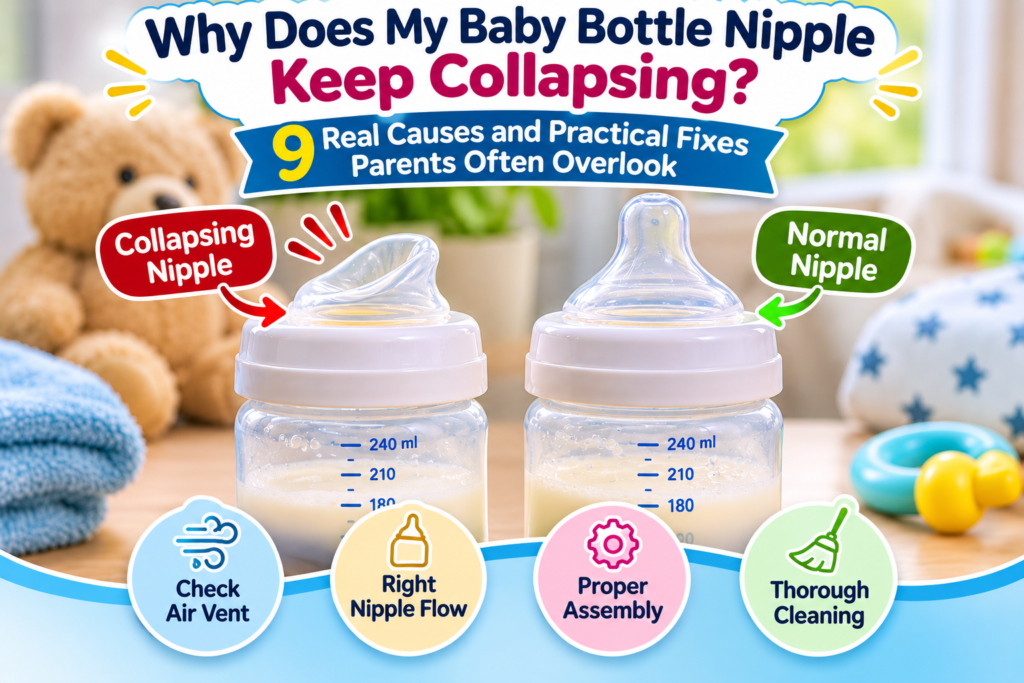
A baby bottle nipple that suddenly flattens during feeding can be confusing. Your baby may be drinking normally one moment, then the silicone nipple folds inward, milk flow slows, and feeding becomes frustrating.
You release the nipple, and it returns to its original shape. But a few minutes later, the same thing happens again.
Many parents assume they need a faster-flow nipple. Others think their baby is sucking too hard.
Neither explanation is always correct.
A collapsing baby bottle nipple is often related to pressure inside the bottle, but it can also involve the nipple’s flexibility, bottle ventilation, assembly, or the way feeding is progressing.
The important thing is to identify what happens immediately before the nipple collapses.
Does it happen after a few sucks? Only when the bottle is half empty? After you wash the bottle? Or only when you use a particular nipple?
These details can help you narrow down the problem without making unnecessary changes to your baby’s feeding equipment.
This guide explains nine possible causes, practical ways to investigate them, and when a bottle problem may actually be a sign that your baby needs feeding support.
Quick Answer: Why Does a Baby Bottle Nipple Collapse?
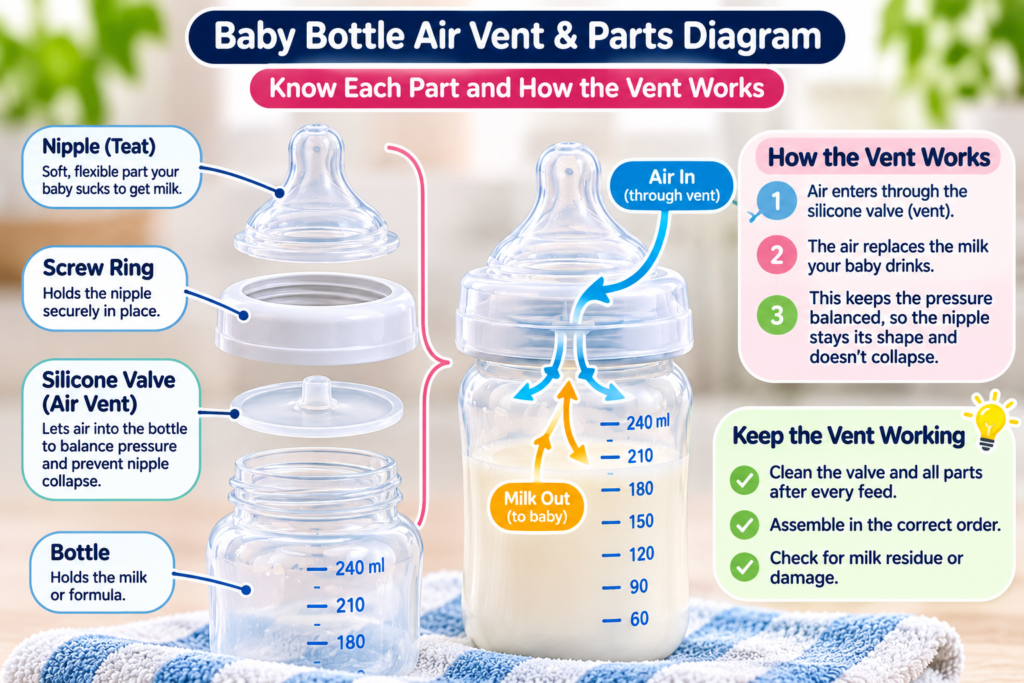
A bottle nipple may collapse when your baby’s suction pulls milk out faster than air can enter the bottle to replace it. This creates negative pressure, sometimes called a vacuum.
A blocked air vent, incorrectly fitted valve, or bottle assembly problem can contribute.
However, a nipple may also flatten temporarily during normal sucking.
The first step is to pause the feeding and gently release the suction—not automatically switch to a faster-flow nipple.
The UK’s National Health Service (NHS) advises gently releasing the vacuum at the corner of your baby’s mouth if the teat flattens during bottle feeding.
The difference between an occasional flattened nipple and a persistent feeding problem is important.
If your baby feeds comfortably and the nipple briefly changes shape, it may not require a major change.
If the nipple repeatedly collapses, interrupts milk transfer, or causes distress, investigate the bottle and feeding process.
What Actually Happens Inside the Bottle When the Nipple Collapses?
Think about drinking through a soft straw.
When liquid leaves a closed container, something must replace the space it occupied. In a ventilated baby bottle, air can enter through a designed pathway.
If that pathway cannot keep up, the pressure inside the bottle decreases.
Your baby continues sucking, but the flexible nipple may begin to flatten inward.
This is why a nipple can sometimes return to its normal shape when suction is released.
But there is an important detail parents may miss:
Not every flattened nipple proves that the bottle’s air vent is blocked.
A soft nipple may temporarily deform under suction even when ventilation is functioning. The baby’s sucking pattern, the nipple design, and the amount of pressure needed to draw milk can all matter.
Instead of focusing only on how the nipple looks, observe whether your baby is transferring milk comfortably.
9 Reasons Your Baby Bottle Nipple Keeps Collapsing
1. The Air Vent Is Partially Blocked, Not Completely Closed
A fully blocked air vent may cause an obvious problem. A partially restricted vent can be harder to recognize.
For example, a bottle may work normally at the beginning of feeding but become difficult to use several minutes later.
The vent may be allowing some air through, but not enough for the conditions of that feed.
This is a possible explanation, not something that can be diagnosed by timing alone.
What to look for:
- The nipple initially maintains its shape.
- Collapse occurs repeatedly after a period of sucking.
- Pausing temporarily improves the problem.
- The same bottle behaves differently from another correctly assembled bottle of the same model.
What to do:
After the feeding, disassemble the bottle and inspect its ventilation components.
Look for dried milk, formula residue, damaged silicone, or a valve that does not sit correctly.
Clean the components according to the manufacturer’s instructions.
Some vents contain narrow openings that should not be stretched, pierced, or altered.
Practical tip: A vent that looks clean is not necessarily functioning correctly. Check its position, condition, and compatibility—not just whether you can see dirt.
2. The Bottle Ring or Vent Components Are Not Assembled Correctly
Parents sometimes focus on the nipple itself while overlooking the parts that hold it in place.
Depending on the bottle, these may include a screw ring, silicone membrane, vent insert, or anti-colic assembly.
A component that is folded, twisted, missing, or incorrectly seated can affect how the bottle functions.
Some bottle systems also require a particular assembly sequence.
A realistic scenario:
Your baby feeds comfortably with the bottle in the morning.
Later, after washing and reassembling it, the nipple begins collapsing.
It may be tempting to blame the washing process or assume the nipple has worn out.
But the difference could simply be how the bottle was reassembled.
What to do:
Compare the bottle with the manufacturer’s assembly diagram.
Check whether each part is seated evenly.
Do not routinely loosen the bottle ring as a workaround unless the manufacturer specifically instructs you to adjust it. An incorrect seal can cause leaks or interfere with the bottle’s intended operation.
3. Your Baby’s Nipple Flow May Be Too Slow for Comfortable Feeding
A slow-flow nipple is not necessarily a problem.
Many babies feed comfortably with slow-flow nipples, including babies older than the age printed on the package.
However, a nipple that requires more effort than your baby can comfortably manage may contribute to difficult feeding.
Possible signs include:
- Repeated frustration while sucking
- Long, tiring feeds
- Pulling away and trying again
- Apparently ineffective sucking
- Difficulty maintaining a comfortable feeding rhythm
These signs are not specific to slow nipple flow. They can also occur with ventilation problems or feeding difficulties.
What parents should know:
Changing to a faster nipple may help some babies, but it can make feeding harder for others.
If the new nipple causes coughing, spluttering, milk leakage, or distress, the flow may be too fast.
Never assume that a collapsing nipple means your baby needs the next flow size.
4. The Nipple Has Become Too Soft, Distorted, or Damaged
Silicone nipples are designed to be flexible, but they are not indestructible.
With use, they can develop tears, cracks, deformation, or changes in texture.
A damaged nipple may behave differently from an undamaged one.
Inspect the nipple for:
- Cracks or tears
- A damaged opening
- Permanent flattening
- Unusual stickiness
- Changes in shape
- Signs of deterioration
If you notice damage, replace the nipple.
Do not attempt to restore a damaged nipple by stretching it, cutting it, or exposing it to extra heat.
A useful comparison: If a new, manufacturer-compatible nipple works normally while an older nipple repeatedly collapses under similar feeding conditions, the older nipple’s condition may be contributing.
This comparison is informative but not a definitive test.
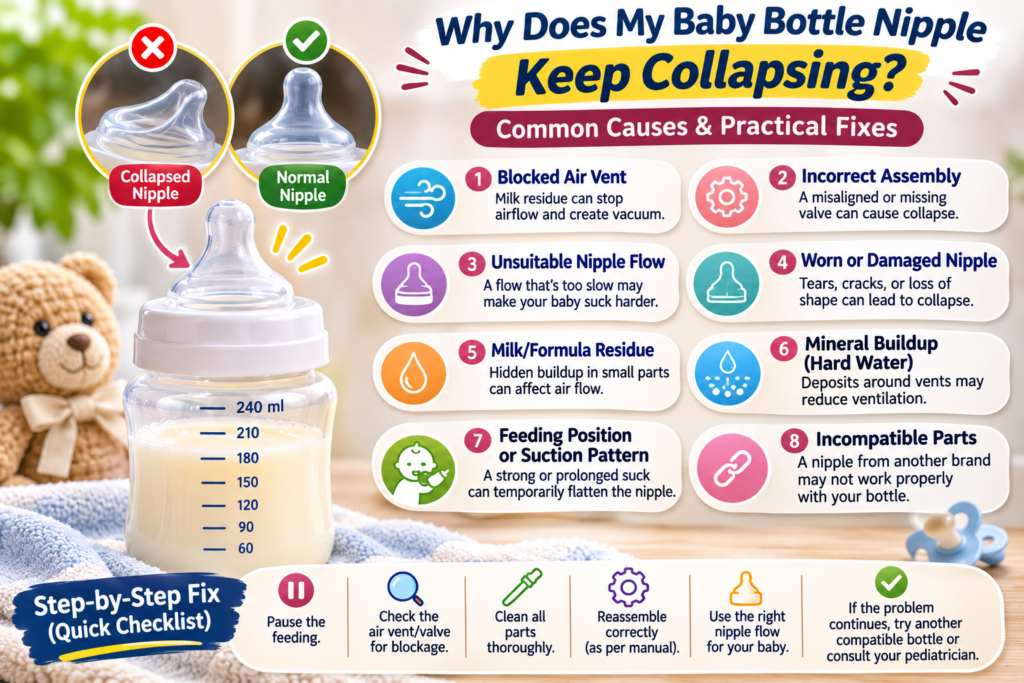
5. Milk or Formula Residue Is Affecting a Small Valve
A bottle can look clean while residue remains around narrow openings or flexible ventilation parts.
Milk and formula contain components that can leave deposits when cleaning is incomplete.
Some valves are small enough that residue is difficult to see without disassembling the bottle.
What makes this problem easy to overlook?
Parents often inspect the large bottle chamber and nipple opening but not the smaller ventilation components.
If you have already dealt with unpleasant bottle odors, your cleaning routine may also deserve a closer look.
For a detailed explanation of residue and odor problems, read our guide: Why Does My Baby Bottle Smell Bad After Washing?.
What to do:
Wash the bottle after every feeding.
Separate all removable parts, including valves and membranes.
Use appropriate bottle-cleaning tools and follow the manufacturer’s instructions.
The CDC recommends cleaning infant feeding items thoroughly and allowing them to air-dry completely.
Do not use sharp objects to clear small holes.
6. Mineral Buildup May Be Present Around Bottle Components
Hard water contains dissolved minerals, primarily calcium and magnesium.
After repeated exposure to water and drying, mineral deposits may appear on bottle surfaces or inside sterilizing equipment.
White, chalky residue is not always harmful by itself, but deposits around moving or flexible components deserve inspection.
Can hard-water residue cause a nipple to collapse?
It is possible that buildup interfering with a ventilation component could contribute to poor performance.
However, the presence of white film does not prove that it is responsible for nipple collapse.
A bottle may have visible mineral deposits and an unrelated feeding problem.
If you notice chalky white marks, read our related guide, White Film Inside Baby Bottles: Is It Hard Water, Formula Residue, or Something Else? [Insert the verified published article link.]
For sterilizers, follow the manufacturer’s descaling instructions.
Do not use vinegar, chemical descalers, or other cleaning agents on bottle components unless their manufacturer permits them.
Important: Water chosen for preparing infant formula must meet the formula manufacturer’s instructions and local health guidance. Do not change formula-preparation water solely to reduce visible mineral spots.
7. The Nipple Collapses Only When the Bottle Is Half Empty
This is a particularly useful observation because it encourages parents to consider the entire feeding process.
Imagine that the bottle works normally for the first few minutes.
Then, when roughly half the milk is gone, the nipple begins folding inward.
You stop feeding, release the suction, and try again.
The nipple works briefly before collapsing once more.
What could explain this?
One possibility is a ventilation system that is not equalizing pressure adequately during the feed.
Another is a change in how your baby sucks as feeding progresses.
Bottle position, nipple flexibility, or the behavior of a particular valve may also contribute.
The exact milk level does not diagnose the problem.
What to check:
- Does the problem happen with the same bottle every time?
- Does it happen with another compatible nipple?
- Does it improve after correct cleaning and assembly?
- Does your baby become tired or change sucking patterns during the feed?
- Does another correctly functioning bottle produce the same difficulty?
Avoid continuing a frustrating feed simply to repeat the problem.
If the issue consistently occurs with one bottle, inspect its parts and contact the manufacturer.
If it occurs across several bottles and your baby struggles to feed, seek feeding advice.
8. The Nipple and Bottle Are Not Designed to Work Together
Some bottle nipples look interchangeable.
But similar size and shape do not guarantee compatibility.
A nipple from one brand may fit into another brand’s ring while altering the intended seal or ventilation pathway.
This matters particularly for bottles with integrated anti-colic features.
A common situation:
You replace a worn nipple with a different brand because it appears to fit.
The bottle no longer leaks, so you assume the replacement is compatible.
But the nipple repeatedly collapses.
The fit may not be functioning as the bottle manufacturer intended.
What to do:
Use nipples and components confirmed as compatible with the exact bottle model.
If the problem started immediately after changing brands or parts, check compatibility before making further adjustments.
9. The Problem May Involve Feeding Coordination, Not Just the Bottle
This is an important distinction.
A baby may struggle with bottle feeding for reasons unrelated to a defective bottle.
Feeding involves coordinating sucking, swallowing, and breathing.
If this coordination is difficult, changing bottles or nipple flow repeatedly may not solve the underlying problem.
Signs that deserve attention include:
- Repeated coughing or spluttering
- Difficulty maintaining a comfortable feeding rhythm
- Frequent distress during feeds
- Unusually tiring or prolonged feeding
- Poor milk intake
- Concerns about weight gain
- Persistent milk leakage alongside other feeding difficulties
These signs do not establish a particular diagnosis.
A pediatrician, qualified infant-feeding professional, or feeding therapist can help determine whether an assessment is needed.
The 60-Second Bottle Nipple Troubleshooting Check
If the nipple collapses during feeding, use this short sequence.
First: Observe your baby.
Is your baby comfortable, breathing normally, and feeding effectively?
If not, stop feeding and respond to your baby’s needs.
Second: Release the suction.
If the nipple is flattened in the mouth, gently release the vacuum at the corner of your baby’s mouth, as recommended by the NHS.
Third: Look at the nipple.
Does it return to its original shape? Is there any visible damage?
Fourth: Consider the pattern.
Did it happen once or repeatedly? Did it start after changing a bottle component?
Fifth: Inspect the equipment after the feed.
Check the vent, valve, ring, nipple, and assembly instructions.
If the problem continues, use another clean, correctly assembled, compatible bottle and seek advice when feeding difficulties persist.
Quick Symptom-to-Cause Guide
| What parents notice | What it may suggest | Sensible next step |
|---|---|---|
| Nipple collapses after several sucks | Pressure or ventilation issue | Inspect the vent and valve |
| Collapse starts after washing | Assembly or component issue | Recheck assembly instructions |
| Only one nipple collapses | Nipple condition or compatibility | Inspect and compare compatible parts |
| Collapse continues after increasing flow | Problem may not be flow rate | Reassess ventilation and feeding |
| Collapse begins halfway through feeding | Ventilation or feeding pattern change | Observe the pattern without forcing the feed |
| Baby coughs with a faster nipple | Flow may be overwhelming | Pause and seek guidance if persistent |
| Baby struggles with several different bottles | Possible feeding difficulty | Ask a pediatrician or feeding specialist |
This table is a troubleshooting aid, not a diagnostic tool.
Why a Faster-Flow Nipple Sometimes Makes the Problem Worse
A faster-flow nipple allows milk to move differently through the nipple opening.
But the bottle’s ventilation system still needs to function correctly.
If the actual problem is a blocked valve or incorrectly assembled bottle, increasing nipple flow may not address the cause.
It may also make feeding less comfortable.
For example, a baby who previously sucked forcefully may suddenly receive more milk than they can comfortably coordinate.
Parents may then notice:
- Coughing
- Milk spilling from the mouth
- Pulling away
- Difficulty pacing the feed
- Increased distress
The solution is not necessarily to keep moving between flow sizes.
Instead, evaluate the bottle system and your baby’s feeding cues.
If you are unsure which flow is appropriate, ask a qualified feeding professional.
What If the Nipple Collapses but Your Baby Seems Perfectly Happy?
This situation is different from a baby who repeatedly struggles to feed.
A nipple may briefly flatten because of suction and then return to its normal shape.
If your baby remains comfortable, feeds effectively, and shows no concerning symptoms, a brief change in nipple shape may not indicate a significant problem.
However, the nipple should not remain permanently distorted or show damage.
Observe the pattern and follow the bottle manufacturer’s guidance.
If feeding becomes difficult or you have concerns about milk intake, seek advice.
What If the Bottle Nipple Collapses After Every Sterilizing Cycle?
Parents sometimes notice the problem immediately after sterilizing.
There are several possibilities.
A valve may have been reassembled incorrectly.
A nipple may have become damaged.
A component may not have been positioned correctly after drying.
Or the timing may be coincidental.
What to do:
Let all components cool according to the manufacturer’s instructions.
Inspect the nipple and ventilation parts.
Check for damage, incorrect positioning, and visible deposits.
Reassemble the bottle exactly as instructed.
Do not assume sterilization is the cause without checking the other possibilities.
Why Does My Baby Bottle Nipple Collapse at Night but Not During the Day?
A bottle does not normally develop a different ventilation requirement simply because it is nighttime.
But feeding conditions can change.
For example, parents may use a different bottle, nipple, or assembly routine at night.
The baby’s feeding behavior may also differ when sleepy.
Rather than assuming the problem is caused by nighttime feeding, compare the equipment and feeding setup.
Check whether the same bottle and nipple are being used during the day.
If the issue appears only during sleepy feeds and your baby struggles to coordinate sucking or swallowing, discuss the pattern with a healthcare professional.
Can a Collapsing Nipple Cause Gas, Reflux, or Colic?
A collapsing nipple may interrupt feeding and cause a baby to repeatedly break suction.
But this does not establish that the nipple is causing gas, reflux, or colic.
These symptoms have many possible explanations.
Anti-colic bottle designs may help manage airflow, but no bottle can guarantee that a baby will not experience feeding discomfort.
If your baby has persistent vomiting, feeding distress, poor weight gain, or other concerning symptoms, seek medical advice.
Should You Loosen the Bottle Ring to Release the Vacuum?
You may see online suggestions to loosen the bottle ring slightly.
However, this is not a universal solution.
Bottle systems are designed differently, and changing the ring’s tightness can affect sealing, leakage, or ventilation.
Follow the manufacturer’s instructions for your exact bottle.
If a properly assembled bottle repeatedly develops a pressure problem, contact the manufacturer rather than improvising a permanent workaround.
Should You Make the Nipple Hole Bigger?
No.
Never cut, pierce, or enlarge a bottle nipple hole.
This can create an unpredictable milk flow and damage the silicone.
If a different flow is appropriate, choose a nipple manufactured for that flow and confirmed as compatible with your bottle.
How to Clean Bottle Nipples and Valves Without Damaging Them
Cleaning is essential, but aggressive cleaning can also damage delicate components.
The CDC recommends cleaning baby feeding items after each use.
A practical routine includes:
- Wash your hands before handling feeding equipment.
- Separate all bottle components.
- Rinse the parts as directed by CDC guidance.
- Wash them with hot water and soap using appropriate cleaning tools.
- Clean the nipple opening according to the CDC’s recommended method.
- Rinse thoroughly.
- Allow the parts to air-dry completely.
- Store them in a clean, protected location once dry.
Follow the manufacturer’s directions for parts that require special cleaning.
The CDC recommends daily sanitizing for infants younger than 2 months, infants born prematurely, and infants with weakened immune systems. For older, healthy babies, daily sanitizing may not be necessary if feeding items are cleaned carefully after every use.
If your nipples develop an unusual soapy taste or smell, see our related guide, Why Do Silicone Baby Bottle Nipples Taste Like Soap? [Insert the verified published article link.]
Do not use abrasive tools, sharp objects, or unapproved chemicals to clean delicate valves.
When Is a Collapsing Bottle Nipple a Reason to Contact a Doctor?
A bottle nipple that briefly flattens is not automatically a medical emergency.
However, feeding difficulties should never be dismissed as merely a bottle problem.
Contact your baby’s healthcare professional if your baby:
- Regularly coughs or splutters while feeding
- Has difficulty coordinating sucking and swallowing
- Consistently feeds poorly
- Becomes unusually tired during feeds
- Has fewer wet diapers than expected
- Is not gaining weight appropriately
- Shows repeated distress during feeding
Seek urgent medical help if your baby has difficulty breathing, turns blue, becomes unresponsive, or appears to be choking.
If the problem persists across multiple correctly functioning bottles, a feeding assessment may be more useful than continuing to change bottle brands.
Frequently Asked Questions
Why does my baby bottle nipple collapse even when the vent is open?
A vent may appear open but still be incorrectly assembled or functioning poorly. Nipple flexibility, suction, and feeding conditions may also contribute. Inspect the complete bottle system rather than assuming the vent is the only cause.
Is a collapsing nipple a sign that my baby needs a faster flow?
Not necessarily. A faster flow may help in some circumstances, but nipple collapse can also be caused by ventilation or assembly problems.
Can I use the bottle if the nipple keeps collapsing?
If collapse repeatedly interrupts feeding, stop using that bottle until you have checked its condition and assembly. Use a properly functioning, compatible alternative and seek advice if your baby continues to struggle.
Why does the nipple collapse after five minutes of feeding?
The timing may be related to pressure changes, ventilation, or a change in sucking behavior. Five minutes alone does not identify the cause.
Can a bottle nipple collapse because of formula thickness?
Different liquids can flow differently, but nipple collapse cannot be attributed to formula thickness without considering the bottle system and feeding conditions. Always prepare formula exactly as instructed. Never dilute or thicken formula to fix a nipple problem unless directed by a qualified healthcare professional.
Why does the nipple collapse with one baby but not another?
Babies may have different sucking patterns and feeding abilities. The same bottle may behave differently under different feeding conditions. If either baby has persistent feeding difficulties, seek professional advice.
Do anti-colic bottles prevent nipple collapse?
Not always. Anti-colic bottles still depend on correct assembly, clean components, and functioning ventilation.
Can a new nipple collapse immediately?
Yes. A new nipple may temporarily flatten under suction, or the bottle system may have a ventilation or assembly issue. A new nipple is not proof that the entire feeding system is working correctly.
Does a glass bottle prevent nipple collapse?
No. Glass bottles still use flexible nipples and may contain ventilation components. The bottle body’s material does not eliminate all causes of nipple collapse.
How often should I replace baby bottle nipples?
Follow the manufacturer’s recommendations and replace nipples immediately if they become damaged, torn, sticky, or permanently distorted. There is no single replacement schedule that applies to every nipple.
Why does the nipple collapse when my baby sucks harder?
Stronger suction may increase nipple deformation or expose an existing ventilation limitation. However, the appearance of the nipple alone does not establish that your baby is sucking excessively.
Should I change bottle brands if the nipple keeps collapsing?
Not necessarily. First check cleaning, assembly, component condition, and compatibility. If the problem continues with a particular model, ask the manufacturer for troubleshooting guidance. Persistent feeding difficulties should be assessed independently of bottle choice.
Final Thoughts: Watch the Feeding Pattern, Not Just the Nipple
A baby bottle nipple that collapses can have several explanations.
Sometimes it is a temporary response to suction.
Sometimes the ventilation system is not functioning as intended.
And sometimes the bottle is working correctly, but your baby needs support with feeding.
The most helpful approach is to observe the pattern, inspect the equipment, and avoid making unnecessary changes to nipple flow.
A comfortable, responsive feed matters more than how quickly your baby finishes the bottle.
If the nipple repeatedly collapses or your baby struggles to feed, seek guidance rather than relying on trial and error.
Related Reading on GetBabyInfo
Baby bottle odors and cleaning
Why Does My Baby Bottle Smell Bad After Washing?
White mineral deposits and residue
White Film Inside Baby Bottles: Is It Hard Water, Formula Residue, or Something Else?
Silicone nipple cleaning problems
Why Do Silicone Baby Bottle Nipples Taste Like Soap?
Cloudy plastic bottles
Why Do Baby Bottles Turn Cloudy After Washing?
Trusted Sources
- NHS — Bottle Feeding Your Baby
- CDC — About Feeding From a Bottle
- CDC — How to Clean, Sanitize, and Store Infant Feeding Items
- CDC — Infant Feeding Item Hygiene FAQs
Editorial note: This article explains general bottle-feeding and equipment troubleshooting. It does not diagnose feeding or medical conditions. Consult your baby’s healthcare professional for persistent feeding problems.