18 min readUpdated November 17, 2026
What this guide covers
- Quick answer: Why Does My Baby Bottle Leak After Feeding?
- The Bottle Was Perfectly Dry—Until Feeding Ended
- Before You Replace Anything, Find the First Drop
- 1. The Last Drops of Milk Are Still Sitting Inside the Nipple
- 2. Milk Has Collected Between the Nipple and the Screw Ring
- 3. The Bottle Starts Leaking When You Put It Down Sideways
- 4. The Anti-Colic Vent Is Releasing Milk That Entered Earlier
- 5. Warming or Mixing Left Liquid in the Wrong Place
- 6. The Nipple or Collar Looks Fine but No Longer Fits Properly
- 7. Milk Is Hiding Inside the Protective Cap
- Why Does My Baby Bottle Leak 5 or 10 Minutes After Feeding?
- How to Stop a Baby Bottle From Leaking After Feeding
- Why Does My Baby Bottle Leak Only When It Is Almost Empty?
- The Three-Minute Bottle Leak Check
- What the Location of the Leak Tells You
- Can the Wrong Nipple Flow Cause Leaking After Feeding?
- Should You Throw Away a Bottle That Leaks After Feeding?
- Don’t Let a Leaking Bottle Become a Cleaning Problem
- When Should Parents Be Concerned?
- Frequently Asked Questions
- Final Thoughts: The Leak May Start Before You Notice It
- Sources and Further Reading
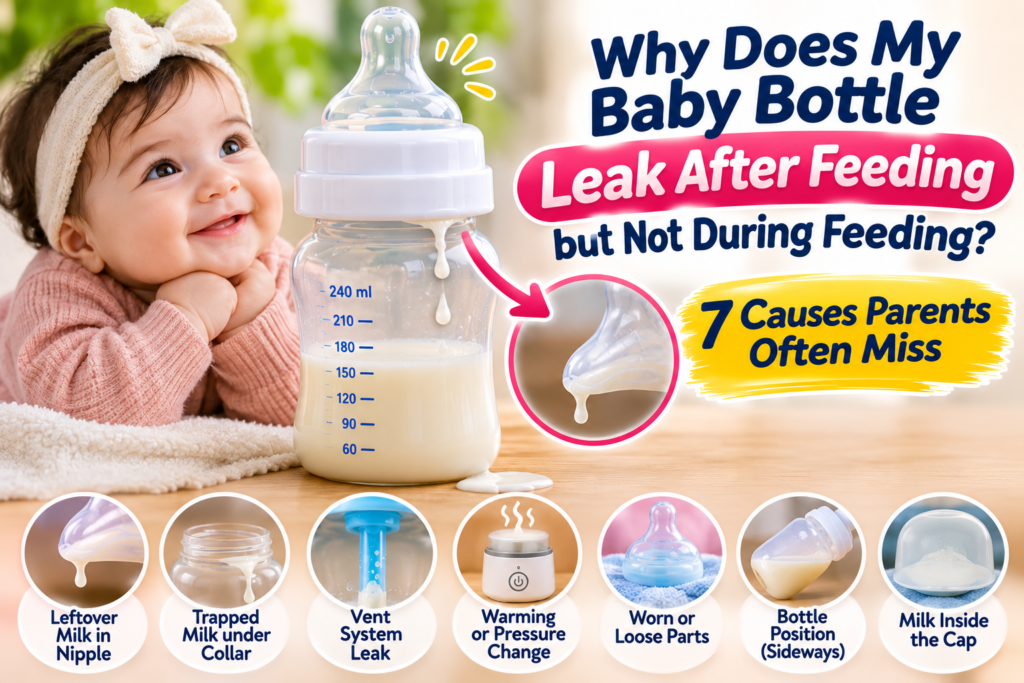
If your baby bottle stays dry while your baby drinks but starts leaking afterward, the cause may be milk left inside the nipple, liquid trapped beneath the screw ring, an anti-colic vent, or the way the bottle is positioned after feeding. Some bottles also leak because of damaged parts or pressure changes during warming.
Start by checking where the first drop appears. A drip from the nipple tip is different from milk leaking under the collar. If the bottle leaks only when you lay it sideways, its ventilation design may be involved.
You may not need a new bottle. Finding the source of the leak can help you decide whether to clean, reassemble, or replace a component.
Quick answer: Why Does My Baby Bottle Leak After Feeding?
A baby bottle that leaks only after feeding may have milk trapped inside the nipple or collar, a vent system that allows liquid to escape when the bottle is tilted, an improperly fitted nipple, or a small amount of milk left around the rim. Pressure changes from warming or formula mixing can also contribute to leaking in some anti-colic bottles.
The easiest way to find the cause is to check where the first drop appears—at the nipple tip, under the screw ring, near an air vent, or only after you put the bottle down.
The Bottle Was Perfectly Dry—Until Feeding Ended
Your baby finishes drinking. You take the bottle away, place it on the bedside table, and reach for a burp cloth.
A few seconds later, there is milk underneath the bottle.
You check the nipple. It looks fine. The screw ring feels secure. Nothing leaked while your baby was drinking.
So why is the bottle suddenly dripping now?
This is the part that makes after-feeding leaks so confusing. Most baby bottle troubleshooting guides explain what to do when milk leaks during feeding. But a bottle that stays dry while your baby drinks and starts leaking afterward may need a different set of checks.
The problem might not even be a damaged bottle.
Sometimes the last drops of milk are simply escaping from the nipple. Sometimes liquid has collected under the collar. And with certain anti-colic systems, the bottle is not designed to remain leakproof when turned sideways.
The important thing is to avoid changing several parts at once. First, find the exact location of the leak.
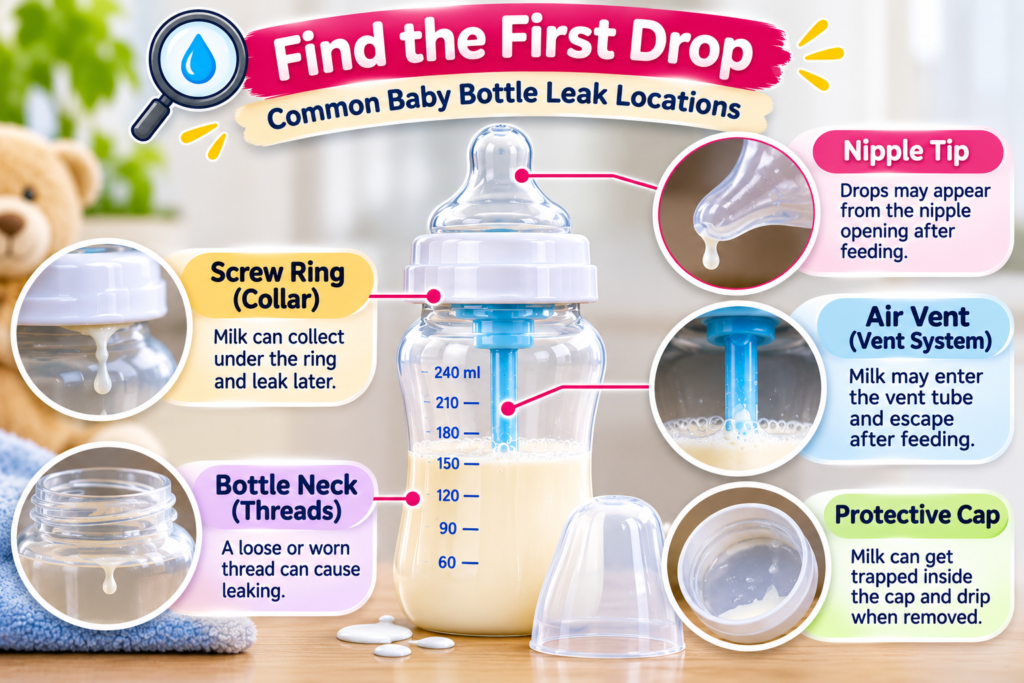
Before You Replace Anything, Find the First Drop
Take a look at what happens immediately after the next normal feeding.
Keep the bottle upright over a clean surface and observe where moisture appears. You do not need to shake it, squeeze the nipple, or deliberately turn it upside down.
Use this table to narrow down the possibilities.
| What you notice | Possible explanation | First thing to check |
|---|---|---|
| One or two drops from the nipple tip | Residual milk in the nipple | Whether dripping stops while upright |
| Milk under the screw ring | Trapped liquid or an imperfect seal | Nipple seating and collar assembly |
| Milk appears after laying the bottle sideways | Vent or nipple allows liquid to escape | Manufacturer’s storage instructions |
| Collar becomes wet several seconds later | Milk escaping from a vent or connection | Vent assembly and preparation routine |
| Leak happens after warming | Pressure-related movement of liquid | Warming instructions |
| Only one bottle leaks | Worn, damaged, or mismatched parts | Compare the bottle’s components |
| Milk appears when removing the cap | Liquid trapped inside the cap | Cap and nipple surfaces |
These are clues, not guaranteed diagnoses. Several causes can produce similar symptoms.
1. The Last Drops of Milk Are Still Sitting Inside the Nipple
When the leak looks worse than it really is
A bottle nipple can hold a small amount of milk after your baby stops sucking.
When the bottle is removed from your baby’s mouth, the remaining milk may drip from the nipple opening.
If you immediately place the bottle on a table, that small amount can create a noticeable wet spot.
It is easy to mistake this for a leak around the bottle’s seal.
What makes this situation different?
The milk appears at the very tip of the nipple rather than underneath the screw ring.
There may be only one or two drops.
The dripping usually stops without any adjustment.
What to do
Hold the bottle upright after feeding and watch where the first drop appears.
If a little milk drains from the nipple and then stops, it may simply be residual liquid.
However, if the nipple continues dripping, inspect it for damage and check the manufacturer’s guidance.
Do not enlarge the nipple hole or squeeze the nipple to force milk out.
A useful distinction: A few leftover drops are different from a steady stream of milk escaping from the bottle.
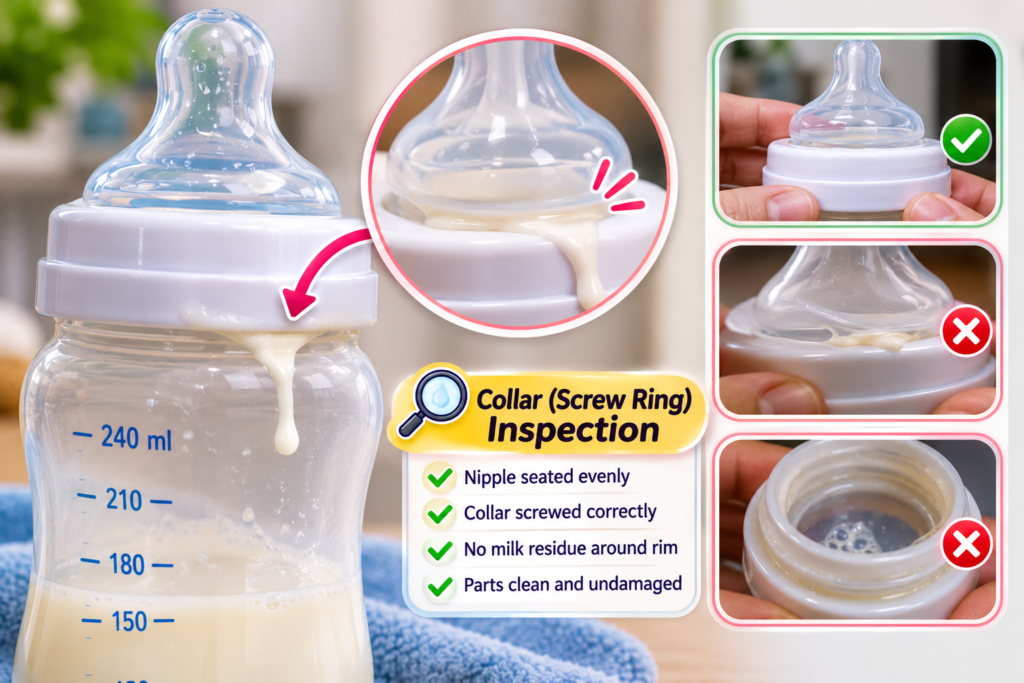
2. Milk Has Collected Between the Nipple and the Screw Ring
The hidden space parents rarely inspect
The bottle may look dry from the outside even when a little milk has collected around the nipple base.
During feeding, the nipple and collar are held at an angle. Milk can contact different surfaces depending on the bottle’s design.
When the bottle is placed upright, residual liquid may move toward the edge of the screw ring.
You might notice a thin line of milk beneath the collar a few seconds after feeding ends.
This does not automatically mean the collar is broken.
But repeated leaking from the same location deserves attention.
Check these details:
- Is the nipple seated evenly inside the collar?
- Is the nipple flange folded or twisted?
- Does the collar fit the bottle correctly?
- Are you using components approved for that bottle?
- Is there visible damage around the rim?
What to do
After feeding, take the bottle apart for cleaning.
Inspect the nipple base and collar for trapped milk, residue, or an uneven fit.
When the parts are clean and dry, reassemble them according to the manufacturer’s instructions.
Avoid assuming that tightening the collar harder will fix every leak. Some vented bottles can leak when assembled too tightly.
If the same problem happens repeatedly, try a manufacturer-approved replacement nipple or collar.
3. The Bottle Starts Leaking When You Put It Down Sideways
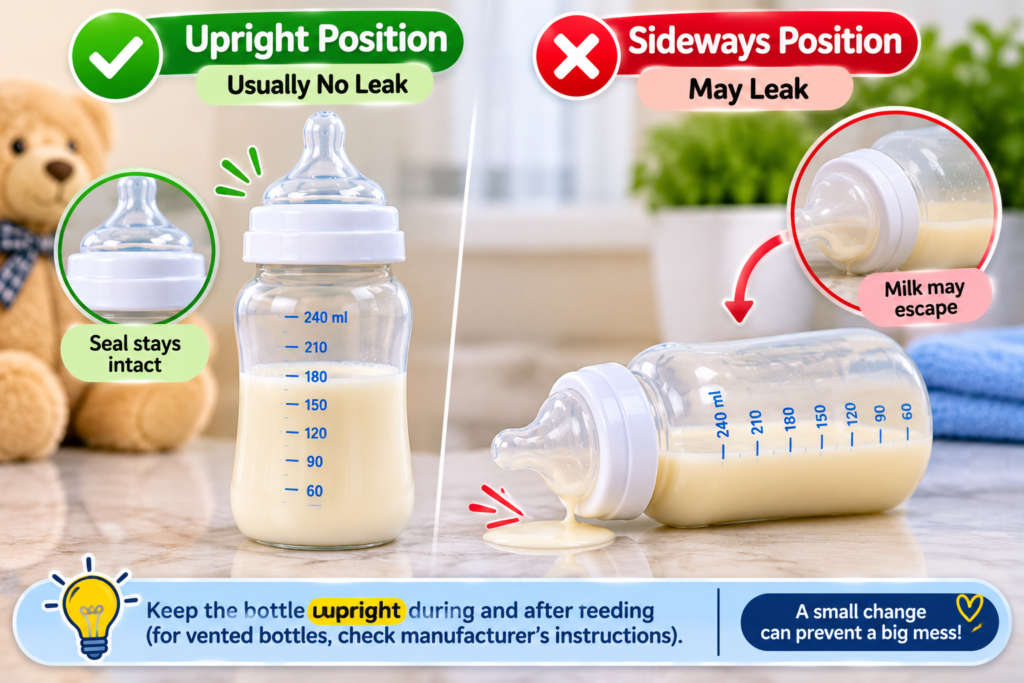
A feeding bottle is not always a leakproof storage bottle
This is one of the most useful distinctions to understand.
Some parents expect a feeding bottle to behave like a sealed water bottle.
But certain anti-colic bottles have ventilation systems that allow air to enter during feeding.
For example, Dr. Brown’s explains that its vented bottles are not completely sealed storage containers when the nipple, collar, and vent are installed.
Milk may escape if the bottle is turned over or placed on its side.
That means a bottle can work properly while your baby drinks and still drip afterward when you change its position.
What to do
Check whether your bottle is designed to remain upright when assembled for feeding.
For Dr. Brown’s bottles, the manufacturer recommends using the appropriate travel disk or storage cap when needed, according to the model’s instructions.
Do not assume that snapping the protective cap over the nipple makes every bottle leakproof.
When this cause is likely
The bottle does not leak while upright.
Milk appears only after you lay it on the bed, changing table, or countertop.
The leak stops when the bottle is returned to the recommended position.
If this describes your situation, check the bottle’s handling instructions before replacing parts.
4. The Anti-Colic Vent Is Releasing Milk That Entered Earlier
The leak begins after feeding, but the problem may have started before it
Anti-colic bottles use different systems to manage airflow.
Some have nipple valves. Others use a base vent or an internal reservoir and tube.
In bottles with an internal vent, milk can sometimes enter the ventilation pathway during preparation, warming, or feeding.
That liquid may later escape around the collar.
Dr. Brown’s identifies shaking formula with its vent installed, overheating, and pressure changes as possible contributors to leaking.
So the milk you notice after feeding may have entered the vent much earlier.
What to check
Does milk collect inside the vent tube?
Does the collar become wet only after the bottle has been moved?
Does the leak happen more often after warming?
Does it happen with formula that was shaken in the assembled bottle?
What to do
Follow the preparation and warming instructions for your specific model.
Check that the vent components are correctly assembled and clean.
Inspect the reservoir, tube, and connections for damage.
Do not remove a vent component unless the manufacturer explicitly allows that bottle to be used without it.
For a detailed explanation, read our related guide:
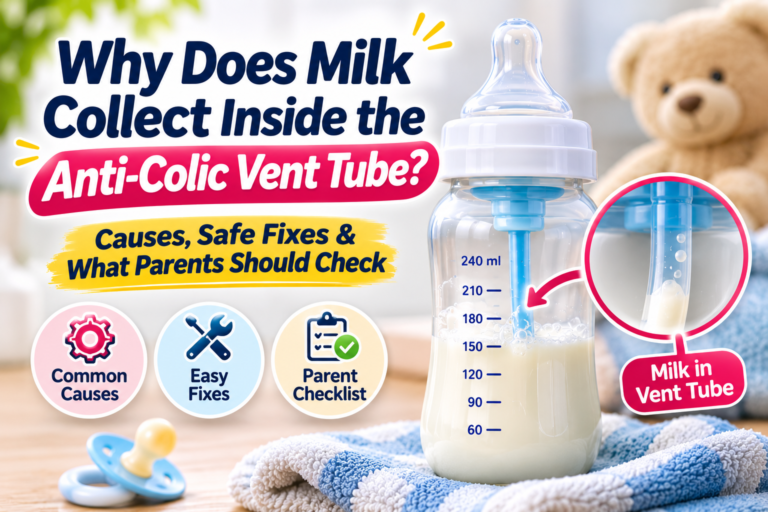
Why Does Milk Collect Inside the Anti-Colic Vent Tube? Causes, Safe Fixes, and What Parents Should Check.
Internal link: Add the published URL of your anti-colic vent article here.
That guide explains how to distinguish milk entering the vent during mixing, warming, and feeding.
5. Warming or Mixing Left Liquid in the Wrong Place
Why a bottle can drip after a feed even when the milk is no longer warm
When a closed bottle is warmed, the air inside it can expand.
Depending on the bottle design, that pressure may move milk into the vent system or toward the collar.
Shaking an assembled vented bottle can also move liquid into areas where it would not normally collect during feeding.
The bottle may then appear to leak later, when you pick it up or put it down.
This is particularly relevant to some Dr. Brown’s systems, which have specific instructions for warming and mixing.
Try comparing your normal routine
Does the leak happen with warmed milk but not with milk served at room temperature?
Does it happen after vigorous shaking?
Does the bottle remain dry when prepared according to its manufacturer’s vent-specific instructions?
These observations may help identify the cause.
What to do
Use the preparation method recommended for the exact bottle model while following safe formula-mixing instructions.
Do not microwave formula or breast milk.
Do not deliberately overheat a bottle to test whether pressure causes leaking.
If you notice repeated leaks after warming, contact the manufacturer rather than experimenting with the vent or collar.
6. The Nipple or Collar Looks Fine but No Longer Fits Properly
Why two identical bottles can behave differently
You may have two bottles from the same brand.
Both use the same milk, the same nipple-flow level, and the same feeding routine.
Yet one leaks after feeding and the other does not.
That difference is worth investigating.
The leaking bottle may have a worn nipple flange, damaged collar, distorted plastic, or a component that does not fit securely.
Sometimes the difference is visible only when you take the bottles apart and compare them carefully.
Inspect for:
- Tears or cracks in the nipple
- A stretched or uneven nipple base
- Damaged screw threads
- Cracks around the bottle neck
- Loose vent connections
- Components from different models that are not approved for use together
If you find damage, replace the affected component.
Do not repair a feeding bottle with glue or tape.
One simple comparison
After both bottles have been cleaned and dried, compare their parts against the manufacturer’s instructions.
If one component is visibly damaged or fits differently, that is a useful clue.
Do not swap parts between bottles unless the manufacturer confirms compatibility.
If the problem persists with a new bottle, contact the manufacturer for troubleshooting.
7. Milk Is Hiding Inside the Protective Cap
The small leak that looks like a collar problem
This is an easy detail to overlook.
When you place a protective cap over a nipple that still has milk on it, some liquid may transfer to the inside of the cap.
Later, when you remove the cap or tilt the bottle, that milk can run down the outside.
It may look as though the bottle has started leaking from the screw ring.
But the liquid may have been sitting inside the cap.
How to recognize it
The bottle appears dry before the cap is added.
Milk appears when the cap is removed.
The outside of the nipple or inside of the cap is wet.
There is no repeated leak from the collar when the cap is not involved.
What to do
After feeding, check the cap and nipple surfaces before taking the bottle apart for cleaning.
If milk has collected inside the cap, wash it along with the other feeding components.
The CDC recommends cleaning bottle caps, nipples, rings, and other feeding parts after every use.
A cap is not a substitute for a model-approved leakproof storage system.
Why Does My Baby Bottle Leak 5 or 10 Minutes After Feeding?
A delayed leak can be particularly confusing.
The bottle seems dry when you finish feeding, but a few minutes later you notice moisture.
The delay may be related to how liquid moves through the bottle or where it has collected.
For example, a small amount of milk may slowly drain from the nipple or a wet collar.
A bottle placed on its side may allow liquid to reach an opening that was above the milk level while upright.
With some vented bottles, liquid already present in the vent assembly may escape when the bottle is moved.
The important question is not simply how many minutes passed. It is what happened to the bottle during those minutes.
Was it moved?
Was the cap added?
Was it laid sideways?
Was it left upright?
Those details may be more useful than the delay itself.
How to Stop a Baby Bottle From Leaking After Feeding
Before buying replacement bottles, try to identify what happens immediately after a normal feeding.
Step 1: Keep the bottle upright. Look at the nipple tip. If only a drop or two comes out and the dripping stops, it may be leftover milk.
Step 2: Check underneath the screw ring. If the collar becomes wet, inspect the nipple flange and ring after disassembling the bottle for cleaning.
Step 3: Notice whether the bottle was laid sideways. Some vented feeding bottles are not designed to remain leakproof in that position.
Step 4: Think about how the milk was prepared. If the leak happens mainly after warming or shaking formula, check the manufacturer’s instructions for your exact bottle.
Step 5: Inspect the parts. Look for cracked plastic, damaged nipples, worn seals, or connections that no longer fit securely.
Step 6: Clean and reassemble the bottle. Follow the manufacturer’s instructions and avoid overtightening or modifying any component.
Step 7: Stop using a bottle that continues leaking unexpectedly. Contact the manufacturer if you cannot identify the problem or suspect a defective component.
A bottle that drips once from the nipple does not necessarily need replacing. A bottle with a damaged seal, cracked part, or persistent leak needs closer attention.
Why Does My Baby Bottle Leak Only When It Is Almost Empty?
Near the end of a feeding, the bottle’s position often changes.
A parent may tilt it further to keep milk reaching the nipple.
That can change which parts of the bottle are in contact with the remaining liquid.
In certain designs, this may contribute to liquid entering a vent or collecting around the nipple.
However, an almost-empty bottle does not automatically cause a leak.
If the problem happens consistently, compare the bottle position and inspect the components.
Follow the manufacturer’s feeding instructions rather than forcing a particular angle.
Also remember that babies should not be encouraged to finish every last drop when they show signs of being full.
The Three-Minute Bottle Leak Check
Before buying another bottle, try this simple observation routine after a normal feed.
First minute: Keep the bottle upright
Look at the nipple tip.
Is there a single drop or continuous dripping?
Then inspect the collar.
Is the first wet spot underneath the screw ring?
Second minute: Check the parts
Once feeding is finished, disassemble the bottle for cleaning.
Look for milk inside the cap, around the nipple flange, and in removable vent components.
Do not intentionally tip a bottle full of milk over your baby’s belongings to reproduce the leak.
Third minute: Think about preparation
Was the bottle warmed?
Was formula shaken with the vent installed?
Was it filled beyond the recommended limit?
Did you use a different nipple or collar?
These details help you decide whether to focus on preparation, assembly, or the bottle’s design.
If you cannot identify the cause and the bottle continues leaking, contact the manufacturer.
What the Location of the Leak Tells You
| Leak location | More useful question to ask |
|---|---|
| Nipple tip | Is this residual milk or continuous dripping? |
| Nipple base | Is the nipple seated correctly? |
| Screw ring | Is the seal secure, or has milk collected underneath? |
| Vent opening | Is the vent assembled and functioning as intended? |
| Protective cap | Was milk already trapped inside the cap? |
| Bottle neck | Are the threads or rim damaged? |
| Under the bottle after laying it down | Is this model designed to remain upright? |
The location of the first drop is often a better starting point than the brand name alone.
Can the Wrong Nipple Flow Cause Leaking After Feeding?
It can be relevant to some feeding-related leaks, but it should not be the first explanation for every delayed drip.
Dr. Brown’s notes that nipple flow can affect pressure and leaking in its vented bottles.
However, a nipple that is too fast can also make feeding uncomfortable or difficult for a baby.
Do not automatically switch to a faster nipple to stop leaking.
Look at your baby’s feeding behavior.
If your baby coughs, splutters, struggles to coordinate sucking and swallowing, or seems unusually frustrated, ask a pediatrician or qualified feeding professional for guidance.
If the nipple repeatedly folds inward, our related article may help:
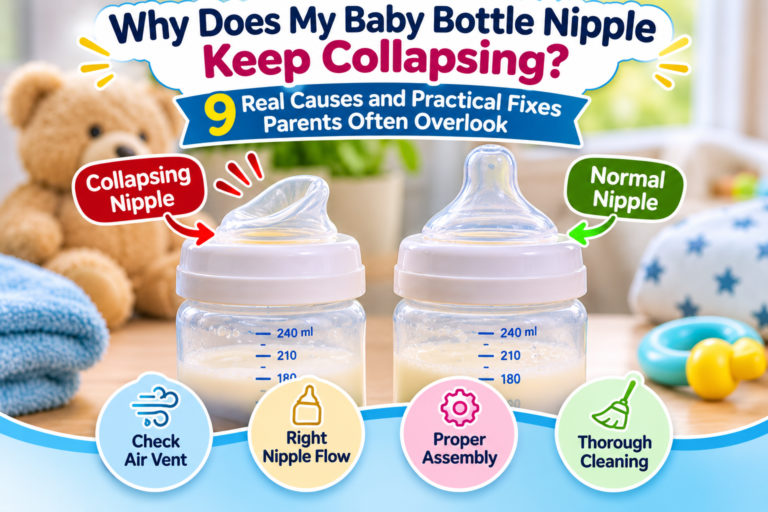
Why Does My Baby Bottle Nipple Keep Collapsing? 9 Real Causes and Practical Fixes Parents Often Overlook.
Internal link: Add the verified published URL here.
Should You Throw Away a Bottle That Leaks After Feeding?
Not every leak means the entire bottle needs replacing.
A small amount of residual milk from the nipple is different from a cracked bottle or a damaged seal.
Start by identifying where the leak occurs.
Clean and inspect the components.
Follow the manufacturer’s assembly and handling instructions.
Replace damaged parts with compatible replacements.
If the bottle continues leaking or does not work as intended, stop using it until the issue is resolved.
Do not modify the nipple opening, block a vent, or improvise a seal.
Don’t Let a Leaking Bottle Become a Cleaning Problem
Milk trapped under the collar, inside a cap, or around a vent can leave residue if the parts are not cleaned properly.
The CDC recommends cleaning infant feeding items after every feeding.
Take apart the bottle, including removable nipples, rings, valves, and vent components.
Wash the parts thoroughly according to CDC and manufacturer instructions.
Allow them to air-dry completely before storing.
Daily sanitizing is particularly important for babies younger than two months, babies born prematurely, or babies with weakened immune systems.
For older, healthy babies, daily sanitizing may not be necessary when feeding items are cleaned carefully after every use.
If your bottle develops a persistent unpleasant smell, read:
Why Does My Baby Bottle Smell Bad After Washing?
For stubborn deposits around the collar or nipple, see:
White Film Inside Baby Bottles: Is It Hard Water, Formula Residue, or Something Else?
Internal link: Add the published URL here.
When Should Parents Be Concerned?
A bottle leaking after feeding is usually an equipment or handling issue.
But if the bottle also leaks during feeding, causes frequent interruptions, or makes it difficult for your baby to drink comfortably, investigate further.
Contact your baby’s healthcare professional if feeding problems occur alongside repeated coughing, choking episodes, poor milk intake, fewer wet diapers, or concerns about weight gain.
Seek emergency help if your baby has difficulty breathing, turns blue, or becomes unresponsive.
Do not assume a feeding difficulty is caused only by the bottle.
Frequently Asked Questions
Why does my baby bottle drip after my baby finishes drinking?
A small amount of milk may remain inside the nipple and drip after sucking stops. If the dripping continues, inspect the nipple and bottle assembly.
Why does my baby bottle leak when I put it down?
Some vented bottles can release milk when placed sideways. Check whether your bottle is designed to remain upright and whether a separate storage cap is required.
Why does milk come out of the bottle nipple after feeding?
Residual milk can drain through the nipple opening. Continuous dripping may also involve nipple condition or bottle design.
Why does my Dr. Brown’s bottle leak after feeding?
Dr. Brown’s bottles use an open ventilation system that can leak under certain conditions. The manufacturer identifies factors including bottle position, pressure changes, preparation methods, and nipple-flow issues.
Why does milk leak from under the bottle ring after feeding?
Possible explanations include trapped milk, an incorrectly seated nipple, damaged parts, or liquid escaping through a vent system. Inspect the components and follow the manufacturer’s instructions.
Why does my bottle leak only after I put the cap on?
Milk may already be present on the nipple or inside the protective cap. Check both surfaces. Remember that a protective cap does not make every bottle leakproof.
Can warming a baby bottle cause leaking afterward?
In some vented systems, warming a tightly closed bottle can create pressure changes that move milk into the vent. Follow the manufacturer’s warming instructions.
Why does my baby bottle leak after feeding but not when I test it?
The bottle’s position, temperature, remaining milk level, and assembly may differ between feeding and testing. Avoid unsafe or forceful tests; observe what happens during normal use.
Can over-tightening a baby bottle cause leaks?
Yes, some bottle manufacturers warn that over-tightening may interfere with proper operation. Follow the model-specific assembly instructions.
Why does one of my baby bottles leak while the others don’t?
Differences in component condition, fit, assembly, or compatibility may explain the problem. Compare the bottles carefully and replace damaged parts.
Is it normal for an anti-colic bottle to leak after feeding?
Some vented bottles may drip when tipped or turned over, but persistent leaking is not something to ignore. Check the manufacturer’s instructions and troubleshoot the exact location.
How do I stop my baby bottle from leaking after feeding?
Identify where the milk first appears. Check for residual milk, nipple seating, collar fit, vent assembly, damaged components, and whether the bottle must remain upright.
Final Thoughts: The Leak May Start Before You Notice It
When a baby bottle leaks after feeding, the obvious reaction is to tighten the lid or replace the nipple.
But the problem may be somewhere else.
Milk might have collected under the collar while your baby was drinking. A vent may contain liquid from preparation or warming. A protective cap may be holding the last few drops. Or the bottle may simply not be designed to stay leakproof when laid sideways.
That is why the first drop matters.
Find where it appears, notice when it happens, and check the parts involved before replacing anything.
A bottle that stays dry during feeding but leaks afterward is giving you a useful clue. You just need to identify which part is releasing the milk.
Sources and Further Reading
- Dr. Brown’s — Frequently Asked Questions and Bottle Leaking
- Dr. Brown’s UK — Why Is My Bottle Leaking?
- CDC — How to Clean, Sanitize, and Store Infant Feeding Items
- NHS — Bottle Feeding Your Baby
This guide is for general educational purposes. Bottle designs vary, so follow the manufacturer’s instructions for your exact model. Consult a healthcare professional about persistent infant-feeding concerns.