10 min readUpdated July 19, 2026
What this guide covers
- Quick Answer
- Why Do Car Seats Expire?
- Is Car Seat Expiration a Marketing Trick?
- How Long Do Car Seats Last?
- How to Find Your Car Seat’s Expiration Date
- Can You Still Use a Car Seat That Looks Brand New?
- When Should You Replace a Baby Car Seat Immediately?
- Should You Buy a Second-Hand Car Seat?
- Signs Your Car Seat May No Longer Be Safe
- How to Dispose of an Expired Car Seat
- Common Myths About Car Seat Expiration
- Final Verdict
- Frequently Asked Questions
- Final Safety Checklist
When I became a parent, I assumed that a good-quality car seat would last forever if it looked clean and had never been in an accident. After all, if something appears perfectly fine on the outside, why would it suddenly become unsafe?
That question led me down a path of researching child passenger safety, manufacturer recommendations, and real-world experiences from parents who had been surprised to learn that car seats actually have expiration dates.
Like many parents, I initially thought expiration dates were simply a marketing tactic to encourage people to buy new products. However, after learning how car seats are designed, tested, and exposed to years of heat, sunlight, and daily wear, I realized there are genuine safety reasons behind these recommendations.
A child car seat is one of the most important safety products you’ll ever buy. It protects your child during every journey, whether you’re driving five minutes to the grocery store or taking a long family road trip. Because these seats are built from plastic, metal, foam, webbing, and moving components, they naturally age over time—even if they still look almost new.
In this guide, I’ll explain why car seats expire, how to check your seat’s expiration date, when it’s time to replace it, and the mistakes many parents unknowingly make that could affect their child’s safety.
Quick Answer
Yes, car seats expire.
Most manufacturers recommend replacing a car seat between 6 and 10 years after its manufacturing date, depending on the brand and model.
Using an expired car seat doesn’t automatically mean it will fail, but it may no longer meet the latest safety standards or provide the level of protection it was originally designed to deliver.
That’s why checking your car seat’s expiration date should be just as important as installing it correctly.
Why Do Car Seats Expire?
This is probably the first question every parent asks.
If the seat still looks clean, has never been involved in a crash, and all the straps seem to work properly, why replace it?
The answer is simple:
A car seat may look perfectly fine on the outside while important safety components inside have slowly weakened over time.
Manufacturers don’t choose expiration dates randomly. They base them on years of testing, material performance, and evolving safety standards.
Several factors contribute to a car seat’s lifespan.
1. Plastic Naturally Weakens Over Time
Modern car seats are made using high-strength plastic designed to absorb crash energy.
Every day your vehicle sits outside, the car seat is exposed to:
- Summer heat
- Freezing temperatures
- UV sunlight
- Humidity
- Temperature changes
These environmental conditions slowly change the structure of plastic.
Even though tiny changes aren’t visible to the human eye, repeated heating and cooling can reduce the material’s strength over many years.
That’s one of the biggest reasons manufacturers recommend replacing older seats.
2. Safety Standards Continue to Improve
Child passenger safety has improved dramatically over the last decade.
Manufacturers regularly update their designs to improve:
- Side-impact protection
- Head support
- Harness systems
- Crash performance
- Installation methods
A car seat that met safety requirements eight years ago may not include today’s latest safety improvements.
Replacing an older seat ensures your child benefits from newer engineering and updated testing.
3. Everyday Wear Adds Up
Even if your child is careful, daily use slowly affects every car seat.
Over several years, a seat experiences:
- Tightening and loosening of harness straps
- Reclining adjustments
- Rotation of moving parts
- Children climbing in and out
- Food and drink spills
- Cleaning products
- Dust and dirt
Each of these may seem minor, but together they gradually wear down important components.
4. Missing Parts Can Affect Safety
As children grow, parents sometimes remove inserts, shoulder pads, or cup holders.
During cleaning, small pieces occasionally become misplaced.
Replacement parts aren’t always available forever.
An older car seat with missing components may no longer provide the protection it was originally tested with.
Is Car Seat Expiration a Marketing Trick?
I’ve seen this question asked many times online.
Some parents believe manufacturers simply want families to purchase new car seats every few years.
After researching recommendations from major brands and child passenger safety organizations, I don’t think that’s the full story.
Yes, manufacturers sell new products.
But expiration dates are also based on practical reasons:
- Materials age.
- Safety technology improves.
- Replacement parts become unavailable.
- Testing standards continue evolving.
Considering that a car seat is designed to protect a child during one of the most severe events a family could experience—a vehicle crash—it makes sense to follow the manufacturer’s guidance rather than relying only on how the seat looks.
How Long Do Car Seats Last?
There’s no universal expiration period.
Different manufacturers recommend different lifespans depending on the materials and design.
Here are general guidelines for some popular brands:
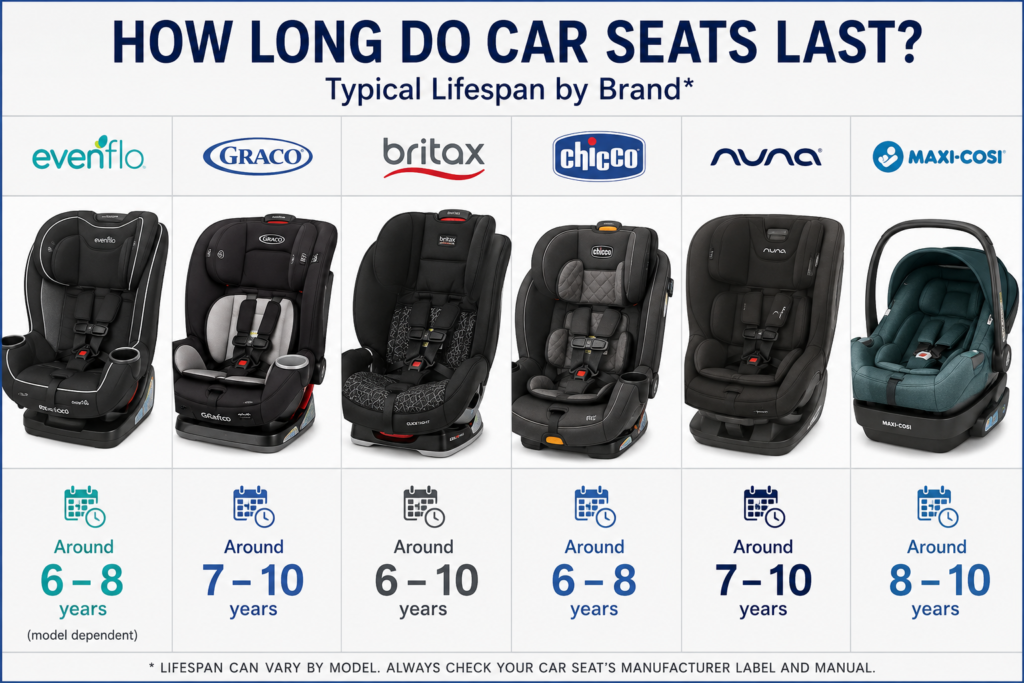
*Always check the label or owner’s manual for your specific model, as recommendations can vary.
How to Find Your Car Seat’s Expiration Date
Many parents assume the expiration date will be printed in large letters on the front of the seat.
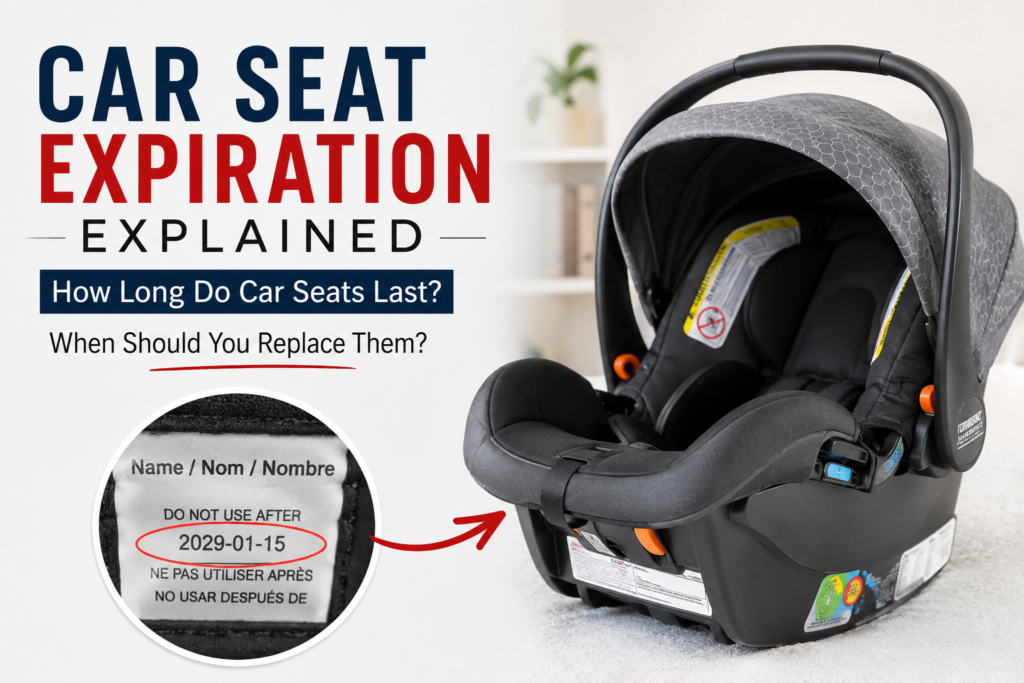
In reality, it may be hidden on a label attached to:
- The bottom of the base
- The back of the seat
- The side shell
- Under the seat padding
Depending on the manufacturer, you might see:
- A specific expiration date
- A manufacture date
- Instructions such as “Do not use after 7 years from manufacture.”
If you can’t find the label, your owner’s manual or the manufacturer’s customer support can usually help identify the seat’s usable lifespan.
Can You Still Use a Car Seat That Looks Brand New?
This is where many parents become confused.
A car seat may:
- Look spotless.
- Have no visible cracks.
- Still buckle correctly.
- Have only been used occasionally.
Even so, appearance alone doesn’t tell the full story.
The materials inside the seat have been exposed to years of environmental stress that you can’t always see.
Just because a seat looks new doesn’t necessarily mean it still performs like a new one during a serious crash.
For that reason, it’s always safer to follow the manufacturer’s recommended lifespan rather than judging the seat by appearance alone.
When Should You Replace a Baby Car Seat Immediately?
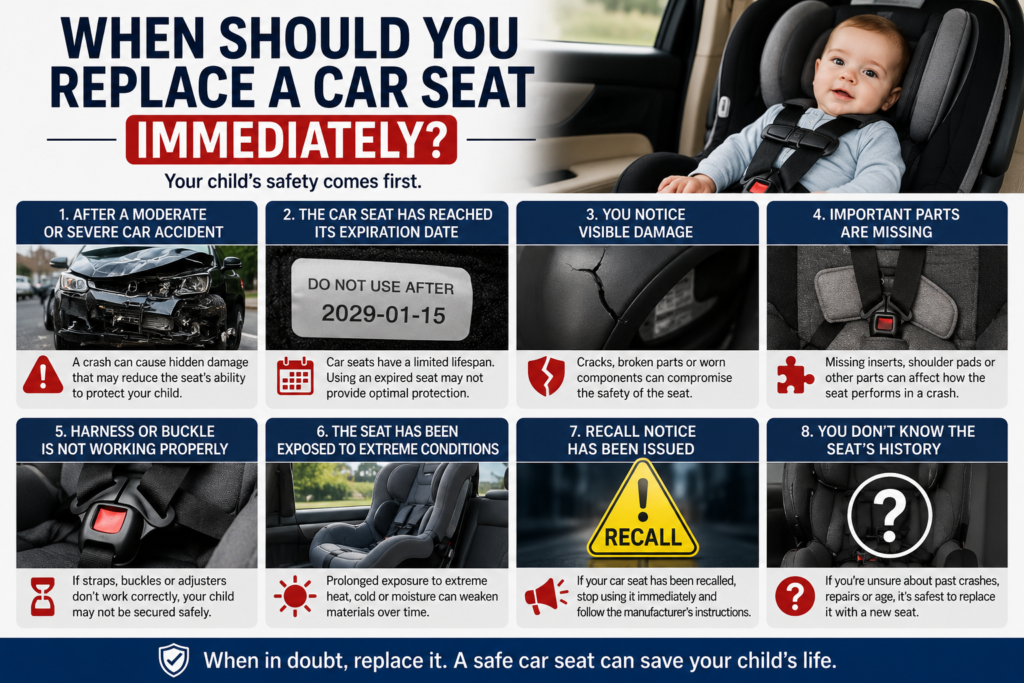
A car seat doesn’t always reach the end of its life because of its expiration date. Sometimes, it needs to be replaced much sooner.
Here are the most common situations where replacing the seat is the safest option.
1. After a Moderate or Severe Car Accident
One of the biggest mistakes parents make is continuing to use a car seat after it has been involved in a crash.
Even if the seat looks perfectly fine, hidden damage inside the shell or frame could reduce its ability to protect your child during another collision.
Some manufacturers recommend replacing the seat after any crash, while others follow the National Highway Traffic Safety Administration (NHTSA) guidance for minor crashes. Always check both your car seat manual and the manufacturer’s recommendations before using the seat again.
2. The Car Seat Has Reached Its Expiration Date
If the manufacturer says the seat has expired, it’s time to stop using it.
The seat may still appear strong, but it has already reached the lifespan it was designed and tested for.
3. You Notice Visible Damage
Replace your car seat immediately if you notice:
- Cracks in the plastic shell
- Broken buckle components
- Torn or damaged harness straps
- Missing foam inserts
- Loose parts that cannot be repaired
- A base that no longer locks securely
Never attempt to repair a damaged car seat using glue, tape, or third-party replacement parts unless approved by the manufacturer.
4. Important Parts Are Missing
Sometimes shoulder pads, infant inserts, chest clips, or harness covers are lost during cleaning.
Although these pieces may seem small, some are essential for the seat to perform correctly during a crash.
If genuine replacement parts are no longer available, replacing the entire seat may be the safest choice.
Should You Buy a Second-Hand Car Seat?
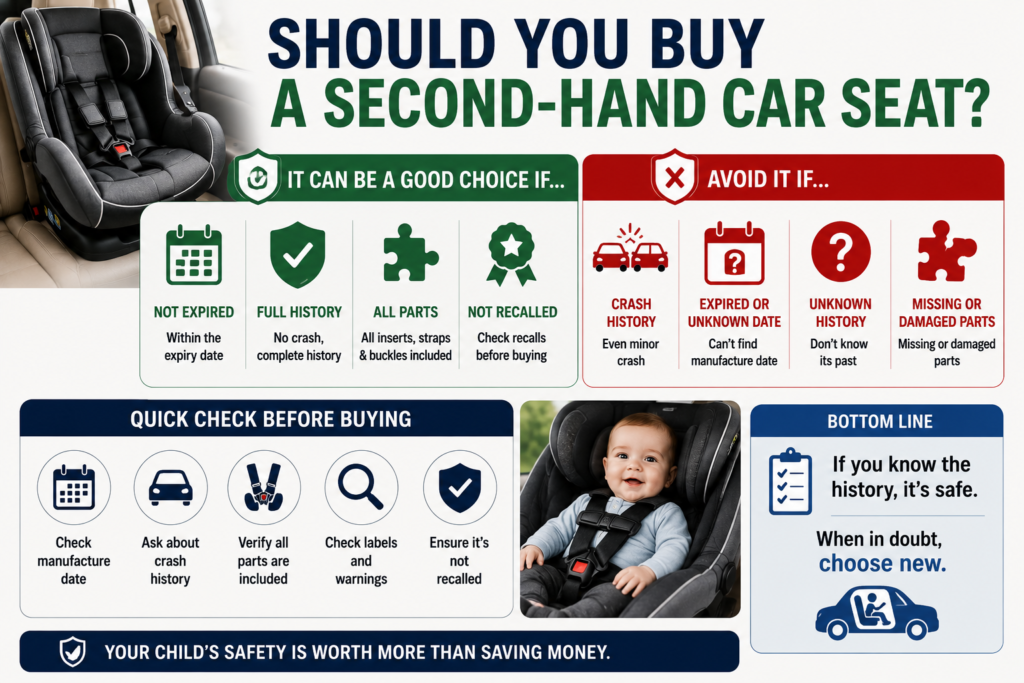
Buying a used car seat can save money, but it also carries risks.
Unless you know the complete history of the seat, it can be difficult to tell whether it has been:
- Involved in a crash
- Stored improperly
- Recalled
- Missing important parts
- Past its expiration date
If you’re considering a second-hand seat, ask these questions first:
- Is it still within its usable lifespan?
- Has it ever been in a crash?
- Are all original parts included?
- Does it still have the manufacturer’s labels?
- Has the model ever been recalled?
If the seller cannot confidently answer these questions, it’s usually safer to choose a new car seat.
Signs Your Car Seat May No Longer Be Safe
Even before the expiration date, certain warning signs should never be ignored.
Watch for:
- Harness straps that no longer tighten smoothly.
- Buckles that stick or fail to click securely.
- Cracks or stress marks in the plastic.
- Loose armrests or moving parts.
- Broken recline mechanisms.
- Missing labels with important safety information.
If something doesn’t feel right, contact the manufacturer before continuing to use the seat.
How to Dispose of an Expired Car Seat
Once a car seat has expired, avoid donating or selling it.
Someone else may unknowingly continue using an unsafe seat.
Instead:
- Remove the harness straps.
- Cut the seat belts if recommended.
- Clearly mark the seat as “Expired – Do Not Use.”
- Check whether your local recycling program accepts child car seats.
- Look for retailer trade-in or recycling events in your area.
Responsible disposal helps prevent expired seats from returning to circulation.
Common Myths About Car Seat Expiration
Myth 1: “It looks new, so it’s still safe.”
Not necessarily.
Many forms of material aging happen inside the plastic and cannot be seen from the outside.
Myth 2: “Manufacturers only want to sell more car seats.”
While manufacturers do sell new products, expiration dates are also based on material testing, product lifespan, and evolving safety standards.
Myth 3: “A car seat lasts forever if it hasn’t been used much.”
Even lightly used seats continue to age because of time, temperature changes, and environmental exposure.
Myth 4: “Any replacement part will work.”
Only manufacturer-approved replacement parts should be used.
Using aftermarket components could affect how the seat performs during a crash.
Final Verdict
A child car seat is one of the few baby products that can truly make a life-saving difference during a crash. While it’s easy to focus on comfort, design, or convenience, understanding when a car seat should be replaced is just as important.
Although replacing a seat that still looks new may seem unnecessary, the reality is that car seats are engineered with a limited service life. Materials age, safety standards improve, and years of everyday use gradually affect how a seat performs.
The safest approach is simple:
- Check your car seat’s manufacturing and expiration labels.
- Register your seat with the manufacturer so you receive recall notices.
- Replace seats after significant crashes when recommended.
- Avoid buying used seats unless you know their complete history.
- Never ignore visible damage or missing parts.
Spending a few minutes checking your car seat today could help ensure it continues to provide the protection your child deserves on every journey.
Frequently Asked Questions
Do all car seats expire?
Yes. Every major manufacturer provides a recommended usable lifespan for its car seats.
How many years does a car seat usually last?
Most models last between 6 and 10 years, depending on the brand and specific product.
Can I use an expired car seat in an emergency?
Safety experts recommend replacing expired car seats as soon as possible. Continuing to use one means relying on a product that is beyond its intended service life.
Is the manufacturing date the same as the expiration date?
No.
The manufacturing date tells you when the seat was made.
The expiration date tells you when it should no longer be used.
Can I donate an expired car seat?
No.
Expired seats should not be donated or sold because they may no longer provide the level of protection they were designed to offer.
Final Safety Checklist
Before your next trip, ask yourself:
- ✅ Is my car seat still within its recommended lifespan?
- ✅ Is it installed correctly?
- ✅ Are the harness straps adjusted properly?
- ✅ Has the seat never been involved in a crash that requires replacement?
- ✅ Are all original parts present and in good condition?
If you answered “yes” to each question, you can travel with greater confidence, knowing you’ve taken important steps to keep your little one safe.