11 min readUpdated October 12, 2026
What this guide covers
- Quick Answer: Why Is My Stroller Veering Left or Right?
- First: Test Whether the Stroller Is Actually Pulling
- Cause #1: Unequal Tire Pressure
- Cause #2: The Front Wheel Isn’t Tracking Straight
- Cause #3: Hair, Thread or Dirt Is Restricting One Wheel
- Cause #4: One Brake Is Dragging
- Cause #5: The Stroller Is Loaded Unevenly
- Cause #6: A Wheel Is Worn, Loose or Installed Incorrectly
- Cause #7: The Stroller’s Alignment Has Changed
- Cause #8: There May Be Frame, Fork or Structural Damage
- A Simple 5-Minute Stroller Pulling Test
- Fix at Home or Stop Using It?
- What Not to Do When a Stroller Pulls Sideways
- What If the Stroller Only Pulls When My Baby Is Sitting in It?
- What If My Stroller Suddenly Started Pulling?
- Frequently Asked Questions
- Final Thoughts
A stroller that constantly drifts left or right can turn a simple walk into an annoying workout.
You start with both hands on the handlebar, but a few seconds later you’re correcting the direction again. On a smooth path it may only feel inconvenient. On uneven ground, slopes, or around traffic, however, poor tracking deserves attention rather than being treated as something you simply have to live with.
The confusing part is that the stroller can look completely normal.
The wheels may still spin. Nothing appears broken. The stroller may even be relatively new.
So why does it keep pulling to one side?
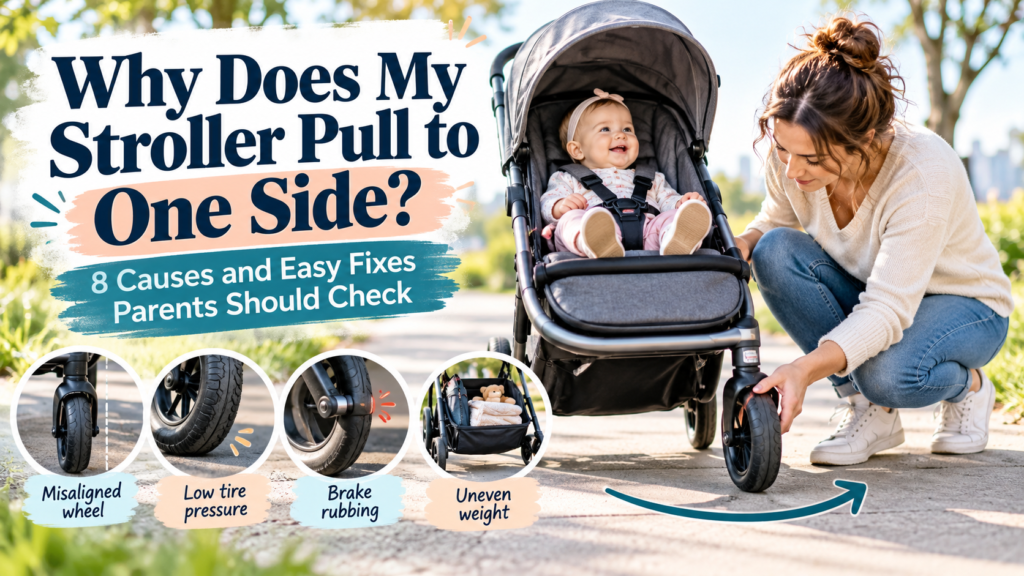
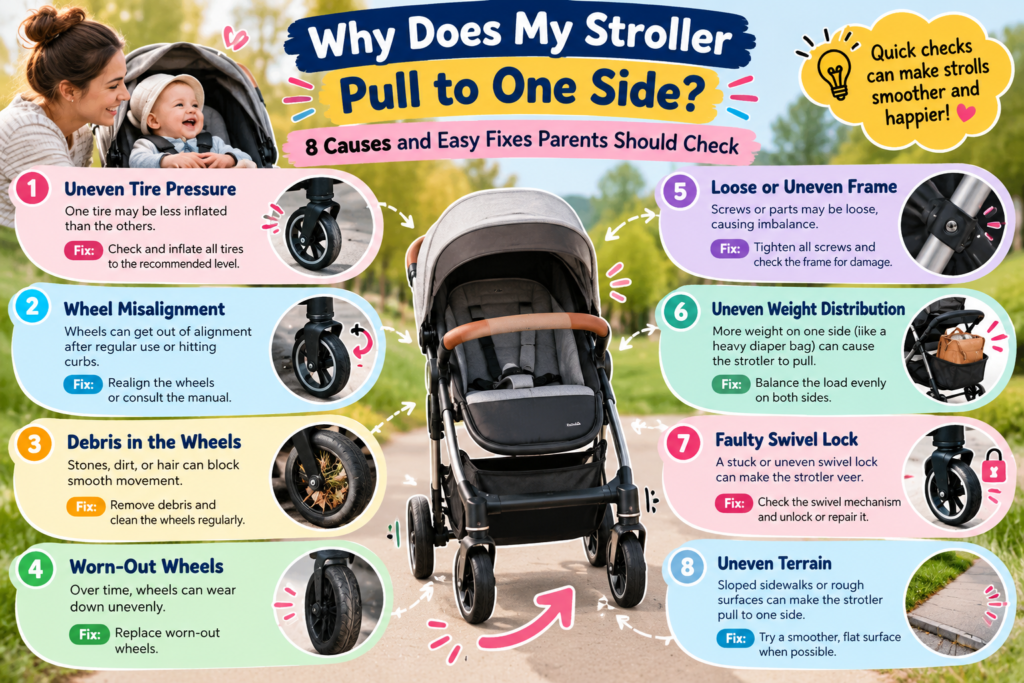
There isn’t one universal answer. Depending on the stroller design, the problem can come from unequal tire pressure, front-wheel tracking, dirt around a wheel, a partially engaged brake, uneven loading, wheel wear, incorrect assembly, or physical damage.
I prefer starting with the simplest checks before touching any adjustment. Many tracking problems can be identified in a few minutes without dismantling the stroller.
This guide walks through that process step by step.
Quick Answer: Why Is My Stroller Veering Left or Right?
If your stroller pulls to one side, first check whether all wheels rotate freely and sit correctly.
For jogging strollers with pneumatic tires, unequal rear tire pressure is a documented cause of pulling. Front-wheel alignment can also affect tracking on models designed to allow that adjustment.
Before changing anything, however, check your stroller’s manual. Wheel systems differ considerably between brands and models, and an adjustment that is correct for one stroller may be inappropriate for another.
A useful troubleshooting order is:
tires → wheel movement → debris → brakes → load → wheel installation → alignment → frame/damage inspection
That order helps avoid unnecessary adjustments.
First: Test Whether the Stroller Is Actually Pulling
Before trying to repair anything, remove the variables that can make a perfectly good stroller feel uneven.
Take your child and all bags out of the stroller.
Choose a flat, level and open surface away from traffic, stairs and slopes.
Check that the stroller is fully unfolded and locked according to its instructions. Make sure the wheels are installed correctly and the brakes are completely released.
Then gently roll the empty stroller forward.
Don’t expect laboratory-perfect tracking. Surface imperfections can affect small stroller wheels. What you’re looking for is an obvious and repeatable drift toward the same side.
Now turn the stroller around and repeat the test in the opposite direction.
Why repeat the test?
If it pulls left going one way but right after you turn around, the surface itself may be sloped.
If it repeatedly pulls toward the same side relative to the stroller, something on the stroller deserves investigation.
This simple test can prevent you from adjusting a stroller that wasn’t actually faulty.
Cause #1: Unequal Tire Pressure
If you own a jogging or all-terrain stroller with air-filled tires, this should be one of your first checks.
Unequal tire pressure changes how each wheel rolls.
On some Baby Trend jogging stroller manuals, for example, the manufacturer specifically identifies unequal rear tire pressure as a cause of the stroller pulling toward the lower-pressure side.
That doesn’t mean every stroller should be inflated to the same PSI.
Never copy another stroller’s tire-pressure number.
Use the pressure specified on your tire, stroller label, or owner’s manual.
What to check
Inspect both tires for:
- visibly different inflation,
- a slow leak,
- punctures,
- damaged valves,
- or one tire repeatedly losing pressure.
Use an appropriate pressure gauge if your stroller uses pneumatic tires.
After correcting the pressure according to the manufacturer’s instructions, repeat the empty-stroller test.
Parent tip
Don’t judge pressure only by squeezing the tire with your fingers. Two tires can feel similar while still being different enough to affect tracking.
Cause #2: The Front Wheel Isn’t Tracking Straight
The front wheel has a major influence on where a three-wheel jogging stroller travels.
Some jogging strollers have a fixed or lockable front wheel that can be adjusted if tracking is off. Manufacturer troubleshooting instructions for certain Baby Trend models specifically describe front-wheel alignment as another possible reason for pulling.
But this is where parents need to be careful:
Not every stroller has a user-adjustable alignment system.
Don’t loosen bolts, bend forks, move axles, or copy an online adjustment tutorial unless those steps match the instructions for your exact stroller.
What you can safely observe first
Stand directly in front of the empty stroller.
Look at whether the wheel appears:
- centered in the fork,
- fully seated,
- straight relative to the frame,
- and securely attached.
Roll it forward slowly and watch the wheel.
If it visibly points to one side or sits differently from how the manual illustrates it, consult the manufacturer’s alignment procedure.
Cause #3: Hair, Thread or Dirt Is Restricting One Wheel
This is one of the easiest problems to overlook.
Stroller wheels collect much more than ordinary dirt.
They can pick up:
- hair,
- thread,
- grass,
- sand,
- pet hair,
- carpet fibres,
- and small pieces of debris.
These materials can wrap around the axle or enter the narrow gap between the wheel and its housing.
One wheel then develops more rolling resistance than the others.
The stroller may feel as though it is “pulling” even though its alignment hasn’t changed.
The spin comparison
With the stroller empty and safely positioned, inspect each wheel and compare how freely they rotate where the stroller design permits you to do so.
You’re looking for a noticeable difference.
If three wheels move smoothly but one stops almost immediately or feels rough, inspect that wheel more closely.
Remove visible hair and debris according to the manufacturer’s cleaning instructions.
Avoid automatically spraying household lubricant into the wheel assembly. Some products can attract dirt or may not be appropriate for plastic, seals, bearings, or braking components.
Cause #4: One Brake Is Dragging
A brake doesn’t always have to be fully engaged to cause resistance.
If a brake mechanism isn’t releasing properly, one rear wheel may drag slightly while the other rolls normally.
That difference can make steering feel heavier on one side.
Signs worth checking
- One wheel is harder to turn.
- You hear rubbing or clicking.
- The stroller became difficult to push after using the parking brake.
- One brake component looks positioned differently from the other.
Engage and release the brake according to the stroller instructions, then check again.
If the brake still doesn’t release correctly, don’t force, bend, or disable it.
A parking brake is a safety component. A malfunctioning brake should be handled according to the manufacturer’s service instructions.
Cause #5: The Stroller Is Loaded Unevenly
Sometimes there is nothing mechanically wrong with the stroller.
The problem is what we’re carrying on it.
A heavy diaper bag hanging from one side of the handle, an overloaded organizer, groceries placed unevenly underneath, or accessories attached to one side can change how the stroller feels.
Before diagnosing a wheel problem, remove everything that didn’t originally come with the stroller.
Test it empty.
Then load the storage basket evenly while staying within the manufacturer’s stated limits.
Avoid hanging heavy bags from the handle unless the stroller manufacturer specifically allows it. Apart from affecting steering, extra handle weight can also affect stroller stability.
If the stroller tracks normally while empty but begins pulling after you load it, investigate the load before adjusting the wheels.
Cause #6: A Wheel Is Worn, Loose or Installed Incorrectly
A wheel doesn’t have to fall off to cause trouble.
Small differences in wheel condition can affect how smoothly a stroller tracks.
Check for:
- uneven tread wear,
- excessive side-to-side movement,
- cracks,
- damaged rims,
- loose wheel attachments,
- or a wheel that isn’t fully seated.
This check is particularly important if the problem appeared after:
- folding the stroller for travel,
- removing its wheels,
- checking it on a flight,
- transporting it in a car,
- or reassembling it after cleaning.
If the stroller began pulling immediately after a wheel was removed and reinstalled, check installation before assuming the stroller needs alignment.
A wheel that won’t lock securely into its intended position should not be improvised with homemade fasteners.
Cause #7: The Stroller’s Alignment Has Changed
If tires, debris, brakes, load and wheel installation all check out, alignment becomes a stronger possibility.
A stroller may begin tracking differently after repeated use or after an impact.
For models with an approved tracking adjustment, follow the exact manufacturer’s procedure and make small changes rather than large ones.
Some manufacturer instructions recommend testing an empty stroller on a smooth surface between small alignment adjustments.
That approach makes sense: changing too much at once can move the wheel from pulling one way to pulling the other.
Important
If your manual doesn’t describe a tracking adjustment, don’t invent one.
Contact the manufacturer or an authorized service provider instead.
Cause #8: There May Be Frame, Fork or Structural Damage
This is the point where troubleshooting should become more cautious.
Think about when the pulling started.
Did it begin after:
- the stroller hit a curb or pothole,
- a wheel took a hard impact,
- airline travel,
- a heavy object fell onto the folded stroller,
- the stroller tipped over,
- or someone forced the folding mechanism?
Inspect the stroller from the front and rear on a flat surface.
Look for obvious asymmetry, a wheel that doesn’t sit flat, a fork that appears distorted, loose joints, cracks, or a frame that doesn’t fully lock open.
Don’t straighten a stroller frame yourself
A bent tube may look like an easy DIY repair, but bending structural parts back into position can weaken them or hide damage.
If you suspect structural damage, stop using the stroller until the manufacturer or a qualified service provider can advise you.
A Simple 5-Minute Stroller Pulling Test
If you’re not sure where to start, use this sequence.
Minute 1: Empty the stroller
Remove your child, bags, organizers, toys and accessories.
Test on level ground.
Minute 2: Check the tires
For pneumatic models, compare pressures using the manufacturer’s specifications.
For solid wheels, inspect for damage and uneven wear.
Minute 3: Check wheel movement
Look for hair, thread and debris.
Compare whether the wheels rotate smoothly.
Minute 4: Check brakes and installation
Confirm the brake releases fully and each removable wheel is securely installed.
Minute 5: Inspect alignment and frame
Stand in front of the stroller and look for obvious wheel or frame asymmetry.
If everything looks normal but the stroller still pulls consistently, consult the model-specific manual or manufacturer rather than making random adjustments.
Fix at Home or Stop Using It?
| What You Find | Best Next Step |
| Unequal pneumatic tire pressure | Correct it to your model’s specification |
| Hair/thread around wheel | Clean according to the manual |
| Uneven storage load | Redistribute/remove the load |
| Removable wheel incorrectly installed | Reinstall exactly as instructed |
| Manufacturer-approved tracking adjustment needed | Follow model-specific instructions |
| Wheel won’t lock securely | Stop and seek manufacturer support |
| Brake doesn’t release properly | Stop and have the brake checked |
| Cracked or damaged wheel | Replace with an approved part |
| Bent fork or frame | Stop using and contact manufacturer |
| Unknown cause after basic checks | Seek manufacturer/service advice |
What Not to Do When a Stroller Pulls Sideways
A few quick fixes can create a bigger problem.
Don’t:
- bend the stroller frame by hand,
- modify the wheel fork,
- disable a dragging brake,
- use random replacement hardware,
- inflate tires beyond their specified pressure,
- spray lubricant onto brake surfaces,
- or follow another model’s alignment procedure.
A stroller carries your child. A temporary steering improvement isn’t worth compromising a safety-critical component.
What If the Stroller Only Pulls When My Baby Is Sitting in It?
This is an important diagnostic clue.
If the stroller tracks straight when empty but pulls after your child and supplies are added, check:
- whether the stroller is being loaded unevenly,
- whether accessories are hanging from one side,
- whether the seat is correctly attached,
- and whether you’re within the stroller’s weight and storage limits.
If a properly loaded stroller still develops a strong one-sided pull only under weight, contact the manufacturer.
Don’t compensate permanently by pushing harder on the opposite side.
What If My Stroller Suddenly Started Pulling?
A sudden change deserves more attention than a stroller that has always had a slight tracking tendency.
Ask yourself what changed immediately before the problem:
Did I inflate the tires?
Remove a wheel?
Clean the stroller?
Use the brake?
Travel with it?
Hit a curb?
Add a new accessory?
Working backward from the first appearance of the problem can often reveal the cause faster than inspecting random components.
Frequently Asked Questions
Why does my stroller keep veering to the left?
Possible causes include unequal tire pressure on pneumatic models, wheel tracking, restricted wheel movement, brake drag, uneven loading, incorrect wheel installation or damage. Start by testing the empty stroller on level ground.
Can low tire pressure make a stroller pull to one side?
Yes, on relevant pneumatic-tire jogging strollers. Manufacturer troubleshooting material for some Baby Trend jogging models specifically identifies unequal rear tire pressure as a cause of pulling. Always use your own stroller’s pressure specification rather than copying another model.
How do I align my stroller’s front wheel?
It depends entirely on the stroller. Some jogging strollers provide a user-adjustable tracking system; others do not. Find the manual for your exact model and follow its procedure.
Why is my stroller suddenly hard to push?
A hard-to-push stroller may have debris around a wheel, low tire pressure, a dragging brake, wheel damage or another mechanical problem. This is related to—but not always the same as—a stroller that pulls sideways.
Can a heavy diaper bag make a stroller steer badly?
Uneven additional weight can change steering and stability. Use the storage areas and weight limits specified by the stroller manufacturer and avoid hanging heavy items from the handle unless explicitly permitted.
Should I keep using a stroller that pulls badly?
Not until you understand why. Minor causes such as tire pressure or debris may be straightforward to correct, but a loose wheel, faulty brake, bent frame or structural problem requires professional/manufacturer guidance.
Final Thoughts
When a stroller starts pulling to one side, don’t jump straight to wheel alignment.
Start with the easy things.
Test the stroller empty on level ground. Check tire pressure where applicable. Inspect each wheel for debris and resistance. Make sure the brake is fully released. Remove heavy accessories. Confirm that removable wheels are installed correctly.
Only then move toward model-specific alignment troubleshooting.
The most important lesson is knowing when not to DIY the repair.
If you find a wheel that won’t lock, a malfunctioning brake, a bent fork, a cracked component or possible frame damage, stop using the stroller and contact the manufacturer.
A stroller that rolls straight is convenient.
A stroller whose wheels, brakes and frame are functioning exactly as designed is far more important.